
Guide
Most Cards Should Not Be Graded. Is Yours the Exception?
Where to look up what a card is worth, how to check the grade you are likely to get, and the arithmetic that turns both into a yes or a no.
Most cards should not be graded. The fee is fixed and the upside is not, so grading only pays when the gap between the raw price and the graded price is bigger than what the grade costs you.
That gap is a number, and you can find it in about ten minutes. This guide is the whole job: where to look up what a card is worth, how to check the grade you are likely to get, and the arithmetic that turns both into a yes or a no.
Sold, not asking
An active listing is a hope. A sold listing is a transaction.
Every useful valuation starts by throwing away the first category. The most common way people overvalue a card is by reading the asking price of something that has been sitting unsold for four months.
Step one: pull the sold comps
Search the card, then open the filters and switch on Sold Items. You are now looking at completed transactions rather than aspirations.
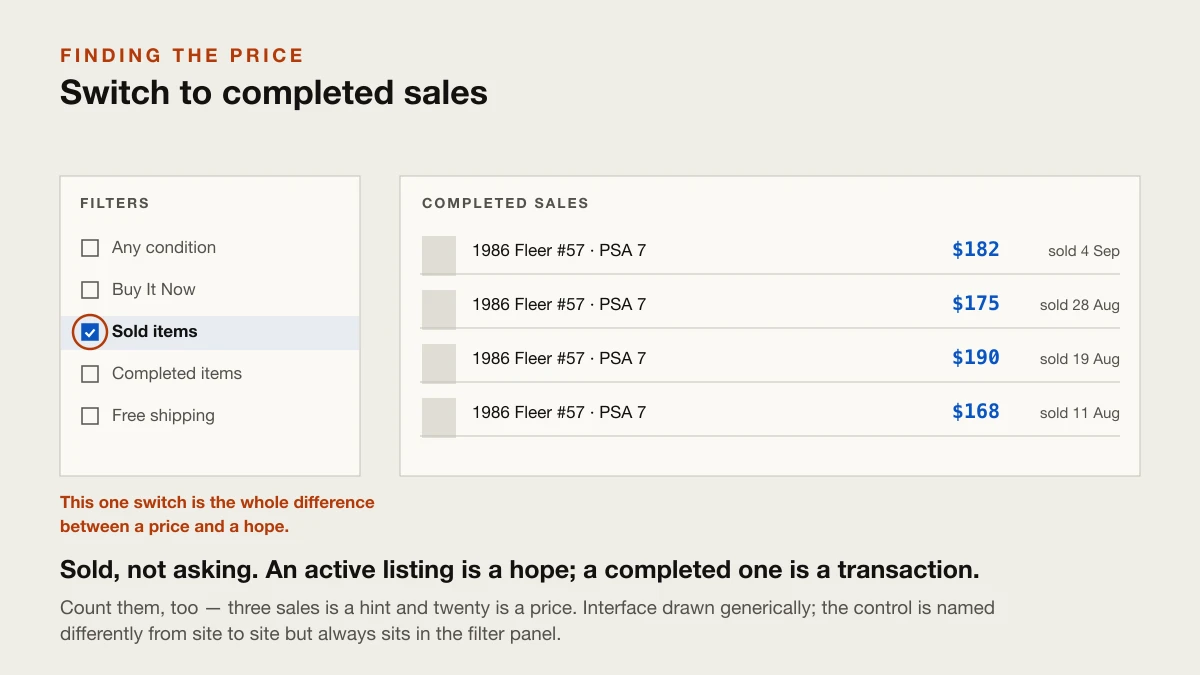
The marketplace app also runs a price guide built on its own first-party transaction data, and that one includes accepted Best Offer prices, which the public sold list does not show. A card listed at $400 that sold on a $260 offer appears as $400 to anyone reading the listing alone.
When you read the results:
- Match the card exactly. Set, year, parallel, serial numbering and card number all move the price, and search results mix them freely.
- Match the grade and the grader. A PSA 9 and a BGS 9 are not comps for each other.
- Check the date. A sale from eighteen months ago is a historical note, not a price.
- Ignore both extremes. One auction that ended at 3am with two bidders is not the market, and neither is one bidding war.
- Count the sales. Three is a hint. Twenty is a price.
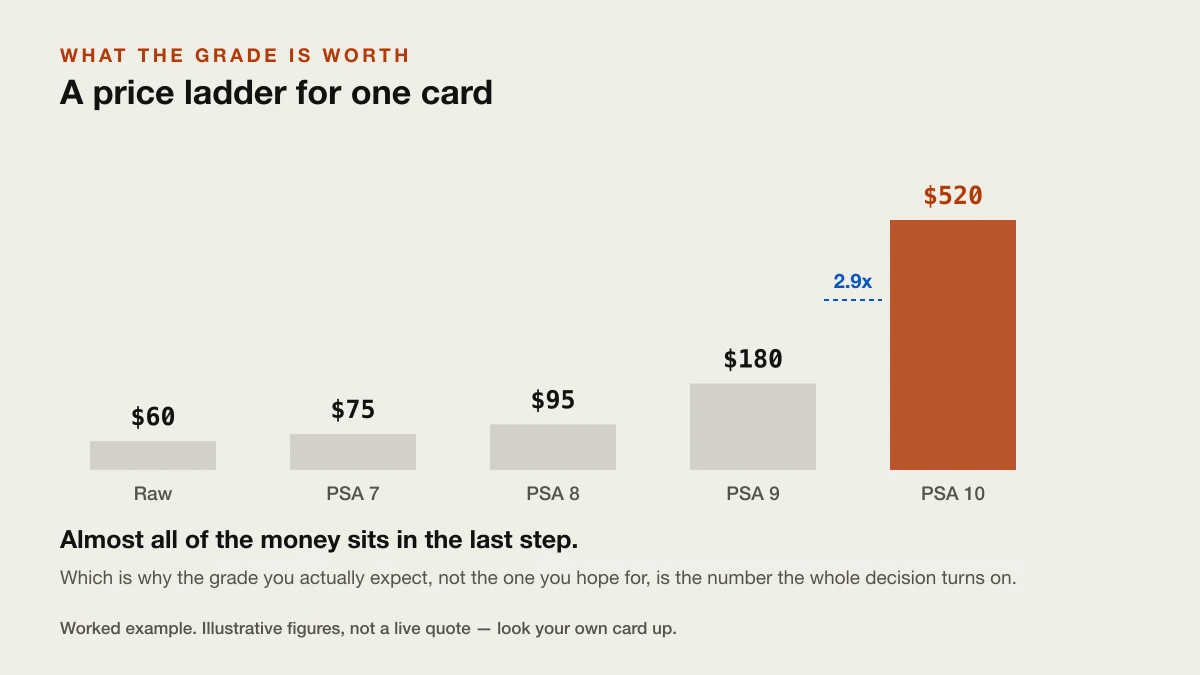
You need two numbers out of this step: what the card sells for raw, and what it sells for at the grade you expect.
Step two: sanity-check with an aggregator
Reading a page of comps by eye is slow and easy to bias. Aggregator sites do the sampling for you and return one figure per card per grade, drawn from sold listings across marketplaces.
They usually carry a few tools worth knowing about — a lot calculator for totalling a collection item by item, a photo appraiser that prices a batch from an image or a pasted list, and collection tracking so a valuation becomes a running position rather than a one-off lookup.
Because those values are algorithmic, treat one as a well-sampled estimate rather than a quote. Where the number decides something, check it against the raw sold comps underneath it.
Step three: check the grade you will actually get
The most common way this calculation goes wrong is pricing a submission at PSA 10 money for a card with an eight per cent chance of a 10.
Look up the population report for the exact card before you commit. If the gem rate is low, the top grade is your upside, not your base case, and pricing the whole decision on it is not analysis. Our guide on reading a population report covers how to find that number and what it does and does not tell you.
The arithmetic
One calculation, four terms:
- The graded price at the grade you actually expect.
- Minus the raw price the card would fetch today, unslabbed.
- Minus the full cost of grading.
- What remains is the spread.
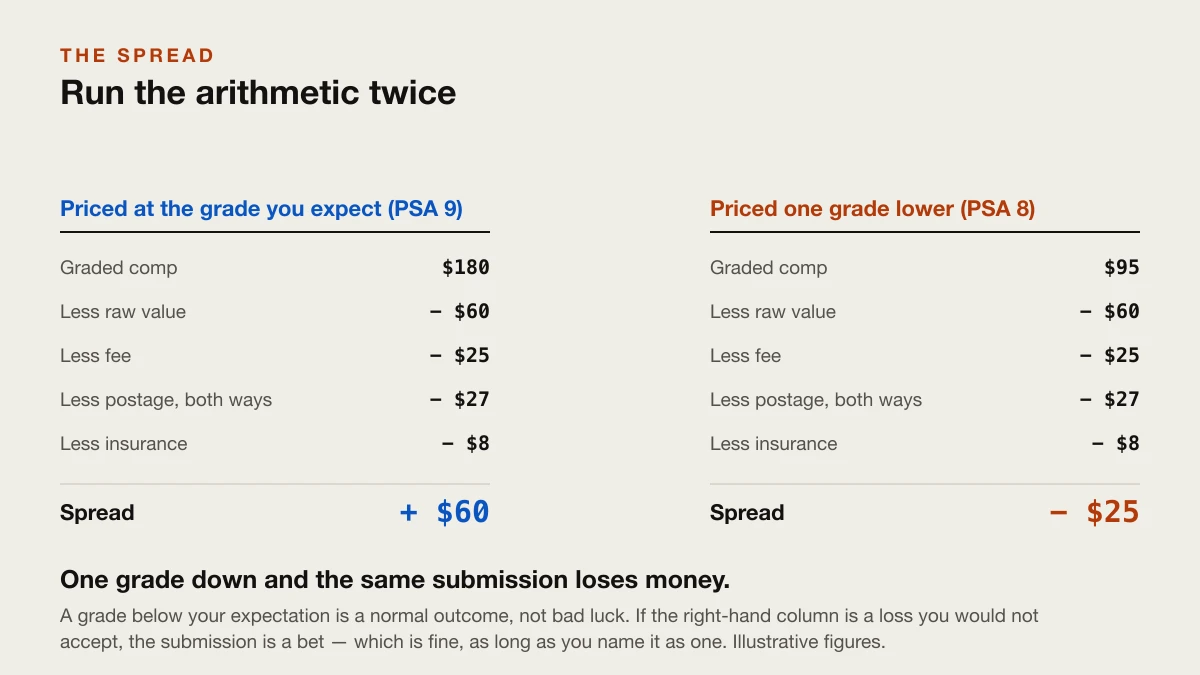
The third term is where people underestimate. The grading fee is not the cost of grading. Add postage to the grader, return postage, insurance on both legs, and any membership the service level requires. A fifty-dollar tier is rarely a fifty-dollar decision.
Then do it twice:
- Price it at the grade you expect.
- Price it again one grade lower, because that is a normal outcome and not bad luck.
If the second number is a loss you are not willing to take, the submission is a bet rather than an investment — which is fine, as long as you name it as one.
When the answer is no
Some cards are clear declines whatever the arithmetic says:
- Raw value below the total grading cost. The grade cannot create value that is not there.
- An obvious capping flaw. A visible surface scratch or a soft corner sets a ceiling, and grading confirms the ceiling rather than removing it.
- Common cards in high supply. A high population at every grade means the market already has all it needs.
- Anything you intend to keep. If the card is not going to be sold, you are buying a display case and a second opinion. That is a legitimate reason — just not a financial one.
When the answer is yes
The case is strongest when three things are true at once: the card is genuinely scarce in high grade, it presents cleanly on all four grading criteria, and the graded comps are both recent and numerous enough to trust.
Two out of three is usually not enough. Grading fees move, and every increase raises the spread a card has to clear before submitting makes sense — so run the numbers against today's prices rather than a threshold you are carrying in your head from last year.