
Guide
Everyone Has a 10 of This Card. Should You Switch Graders?
The top grade is not scarce at your usual grader. Whether a different one actually helps — and the narrow cases where it does.
You looked up the population report, found forty thousand of your card already sitting in the top grade, and had a reasonable thought: if the 10 is not scarce here, maybe it is scarce somewhere else. Grade it with a different company, land in a much smaller population, and own something rarer.
The instinct is sound and the answer is usually no. It is worth understanding exactly why, because the narrow cases where switching does work are real — and they are not the ones most people pick.
What a high gem population actually tells you
A large top-grade population is a fact about the card, not about the grader.
It means the card is easy to grade well — well-centred out of the pack, printed cleanly, cut evenly, and probably produced in a modern print run with good quality control. Those properties travel with the cardboard. Send it somewhere else and it is still an easy card to grade well; it will just be measured against a different scale.
So the question is never "where is this grade rarer." It is "does anyone pay more for the rarer version."
The trap: scarcity you find is not scarcity anyone pays for
This is where the strategy usually dies.
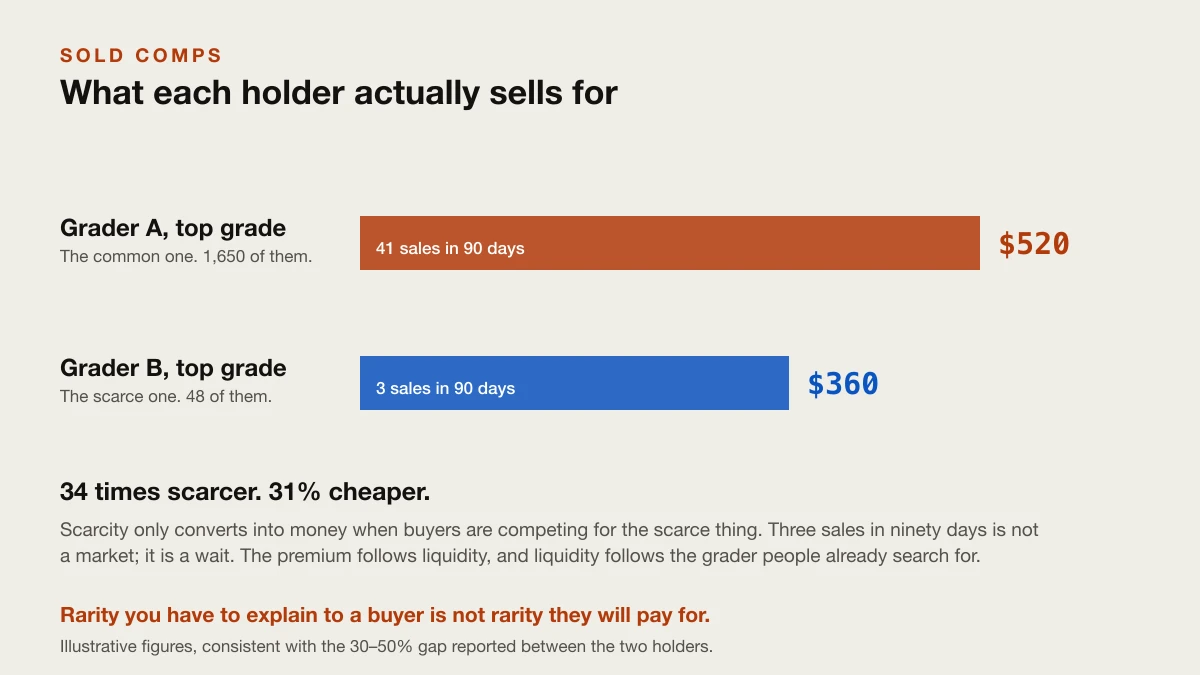
Take the most common version of the trade — a card that would grade 10 at the market-leading grader, sent instead to a company whose equivalent top grade has a fraction of the population. You have genuinely created the scarcer object. You have also, in most cases, created the less valuable one.
The market-leading grade routinely sells at a substantial premium over the scarcer equivalent from a smaller or more demanding grader — commonly tens of per cent, and multiples on some vintage and blue-chip cards. The reason is not that the scarcer slab is worse. It is that buyers are paying for liquidity and confidence, not for rarity.
Scarcity only converts into money when there is competition for the scarce thing. A grade nobody is hunting is not scarce in any sense that matters — it is just uncommon, and uncommon and sought-after are different words.
Never add populations across graders
One piece of arithmetic to get right before any of this, because almost everyone gets it wrong.
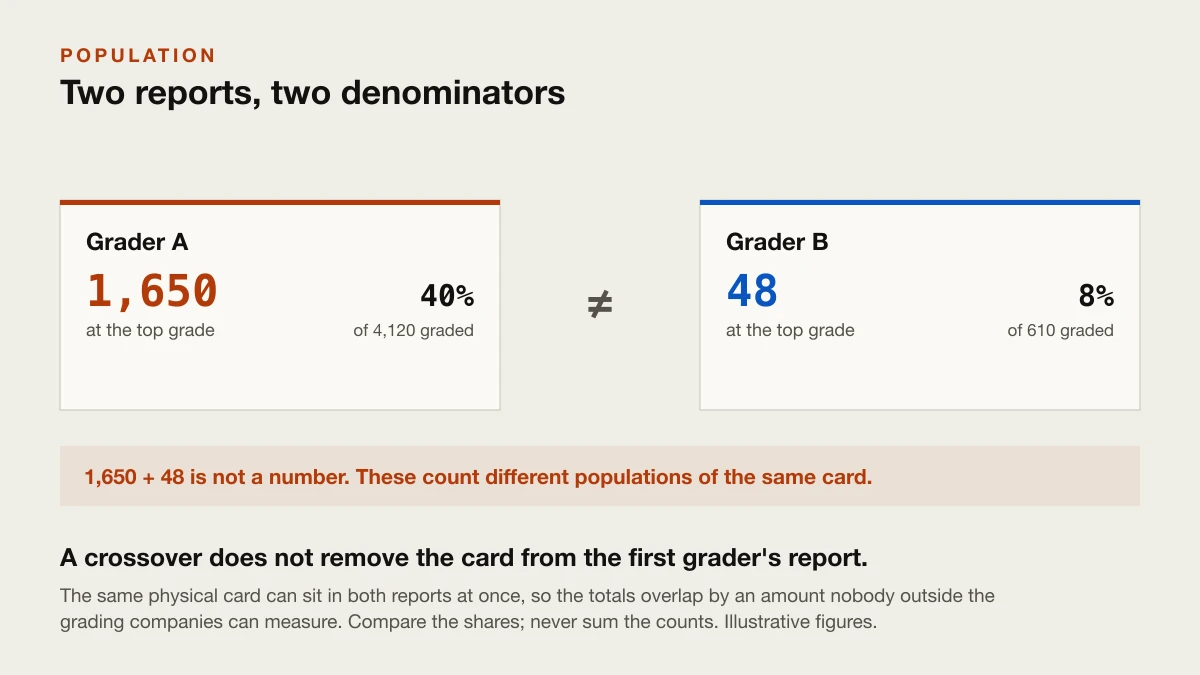
When a card is cracked out of one company's holder and successfully graded by another, the first company's population does not go down. It cannot — the company has no way of knowing the slab was broken. The card now appears in two population reports at once, and it is the same physical card.
That means totals across graders are inflated by an unknown amount, and summing them produces a number that describes nothing. Read each grader's population on its own terms, and read the population of the grader you would actually sell into.
When switching is genuinely the right call
There are real cases. They are narrower than the instinct suggests, and none of them are about manufacturing rarity.
- The card is vintage and the grader has a reputation there. Some companies are trusted more on pre-war and mid-century material than their overall market share implies, and that trust shows up in the price.
- Subgrades are the product. For high-end modern cards, a graded breakdown of centring, corners, edges and surface is information a buyer will pay for, and the top grade with perfect subgrades is a genuinely different object from a plain top grade.
- You are keeping the card. If it is going in a display and not to auction, the holder you prefer looking at is a perfectly good reason, and resale liquidity is irrelevant to you.
- The economics only work at the lower fee. If the spread on the card is thin, a cheaper grader with acceptable recognition can be the difference between a submission that pays and one that does not — provided you have checked that the market accepts the label at all.
- Turnaround decides the trade. If the card is inventory rather than a keepsake, cards sitting in a queue are money not working, and a faster grader with a slightly weaker label can still be the better business decision.
Notice what is absent from that list: "because the population is lower." Low population is never the reason on its own. It is a fact you check after you have established that the market pays for the label.
If you do switch, know what you are buying
Two routes, and they are not equivalent.
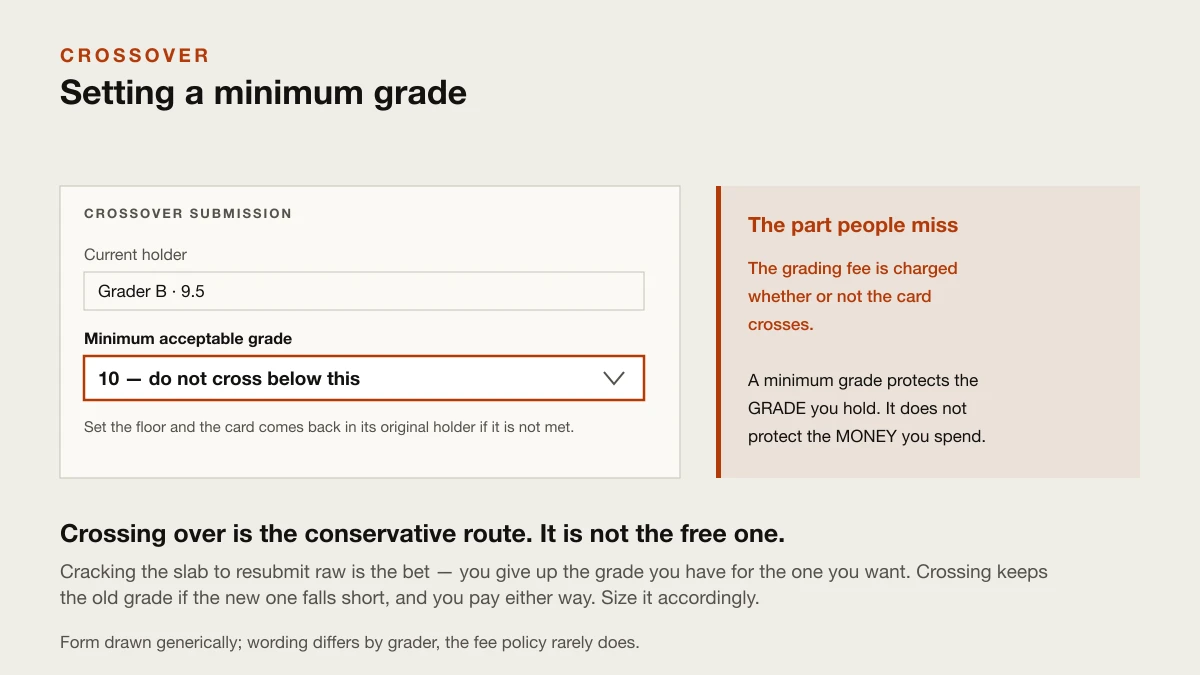
Crossing over submits the card still sealed in its current holder. You nominate a minimum grade you are willing to accept, and the card only moves into the new holder if it meets or exceeds it. If it does not, it comes back exactly as it went out — and you pay the full fee either way. That last part is the one people miss: a failed crossover costs the same as a successful one.
Cracking and resubmitting takes the card out of the holder and sends it in raw. It removes the minimum-grade safety net entirely. The card is now exposed to a fresh opinion with no floor, and any handling damage between holders is yours.
Crossing over is the conservative route and it is usually the right one. Cracking a slab to chase a grade is a bet, and it should be sized like one.
The decision, in one line
Switch graders when the market you plan to sell into pays for the other label, when the card genuinely suits what that grader is known for, or when the fees and turnaround change the arithmetic.
Do not switch because a number in a population report is smaller. Rarity you have to explain to a buyer is not rarity they will pay for.