
Cardboard Journal's Take
MBA (Mike Baker Authenticated)
MBA does two jobs: it grades raw cards in its own holder, and it stickers other graders' slabs with a second opinion.

What Sets Them Apart
Mike Baker was PSA's first employee and its Director of Grading for over a decade, and MBA sells that eye two ways. Raw cards are graded and sealed in an MBA holder, aimed squarely at the sub-$250 cards the majors price out. Already-slabbed cards get a Diamond sticker instead — a second-opinion grade that leaves the original holder intact, the closest thing cards have to CAC in coins. Every submission carries a Heat Map showing where the condition flaws that capped the grade actually are, which no major grader publishes.
Tier
Our rating of how well the resale market actually recognises this grader.
Turnaround
30 business days
That is the standard raw tier; $50 buys 15 business days. Crossover work is quoted per submission, and a two-hour digital review is offered at shows. Raw grading is not open to the public — MBA takes it only through approved business submitters, so most collectors reach it through a dealer.
Backlog
No backlog figure published.
What They Grade
- Sports Cards
- TCG
Marketplace Acceptance
Certificate lookup:Verify a cert →
A real premium exists on MBA-stickered slabs relative to identically graded unstickered ones, concentrated in high-end vintage where the buyer pool knows what the sticker means — a gold-diamond Griffey took a record at Heritage. That evidence is about stickers on other graders' holders. MBA's own slab is new and carries none of it: there is no resale record showing the market pays for an MBA-graded card the way it pays for the sticker. Neither is recognised by eBay's Authenticity Guarantee or carried as a category by the major auction houses.
Pricing
Two ladders. Raw grading is $15 at 30 business days or $50 at 15, plus a final value fee by the card's value: $15 up to $100, $20 up to $250, $25 up to $500, $35 up to $1,000, then 3% of the excess. The turnaround fee is credited against that final value fee. Crossover is charged the same way, at 3% over $1,000, dropping to 1% if MBA has already Diamond-certified the card. Cards over $25,000 can be submitted for a $0 base fee, paying only if a Diamond is awarded. At shows, a two-hour digital review runs $25 and credits toward a later crossover.
Prices change often, so we link to each grader's own list rather than copying figures that go stale.
The Slab
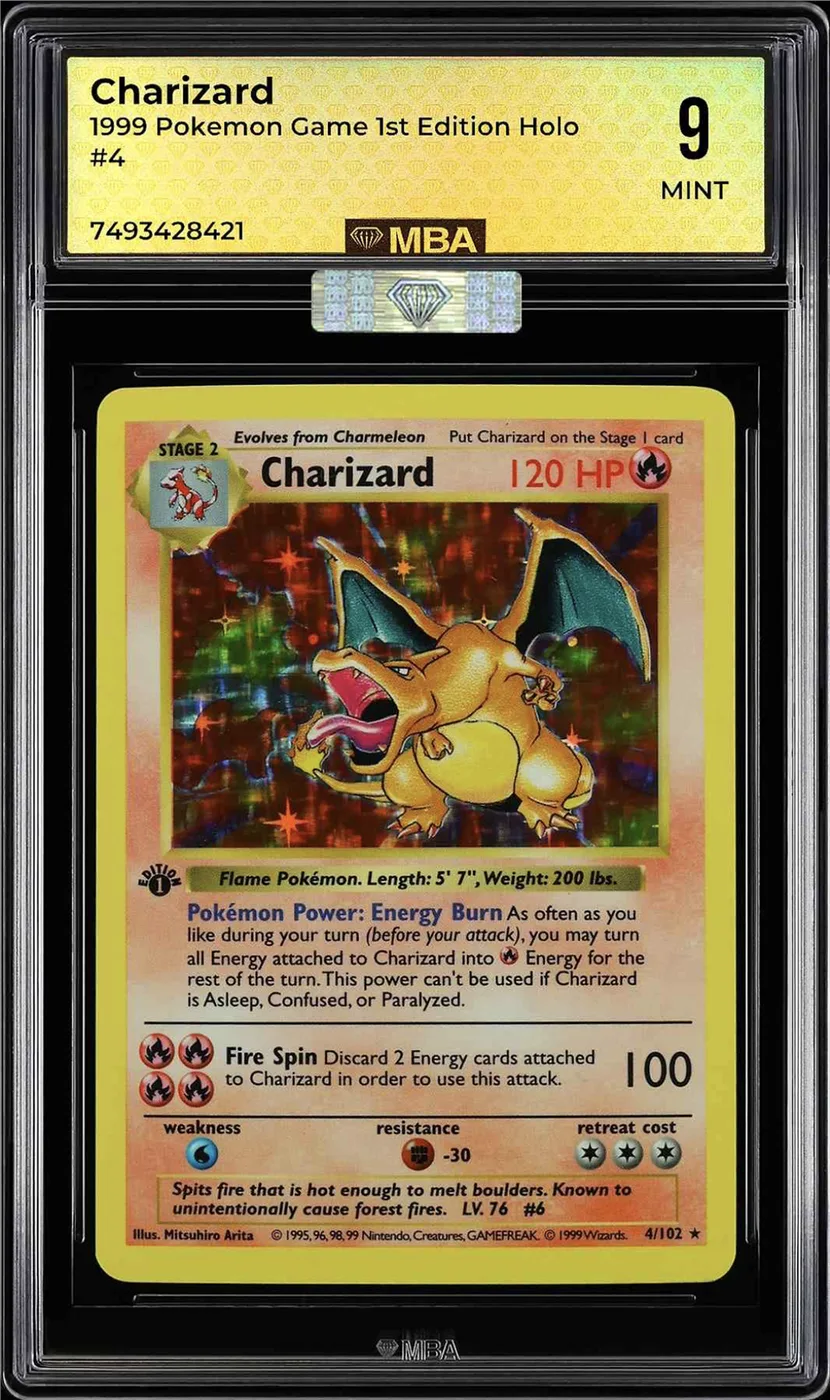
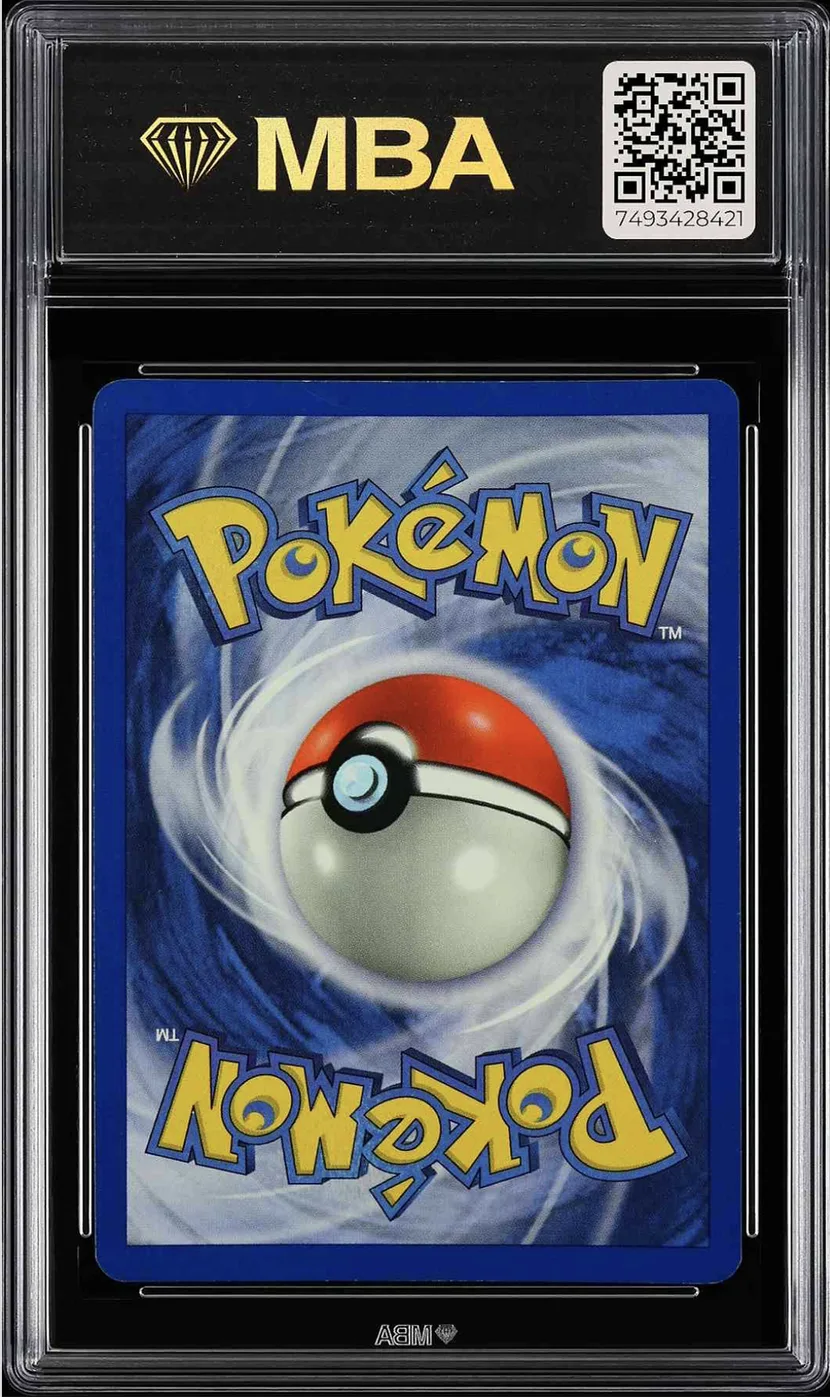
MBA does slab, and its own holder is a clear acrylic jewel case the company says was chosen to sit beside PSA slabs on a shelf. It takes cards up to 360pt and 6x8in. Two of the three services leave the card where it is: a Diamond crossover keeps the original third-party holder and adds a sticker to the case. Black Diamond cards are the exception among stickered cards — they cross into a dedicated MBA Black Diamond slab. Any Diamond card can be crossed into an MBA holder later, and the grade and tier travel with it.
Example slab shown for reference — not a card I personally own.
The Label
SubgradesNone
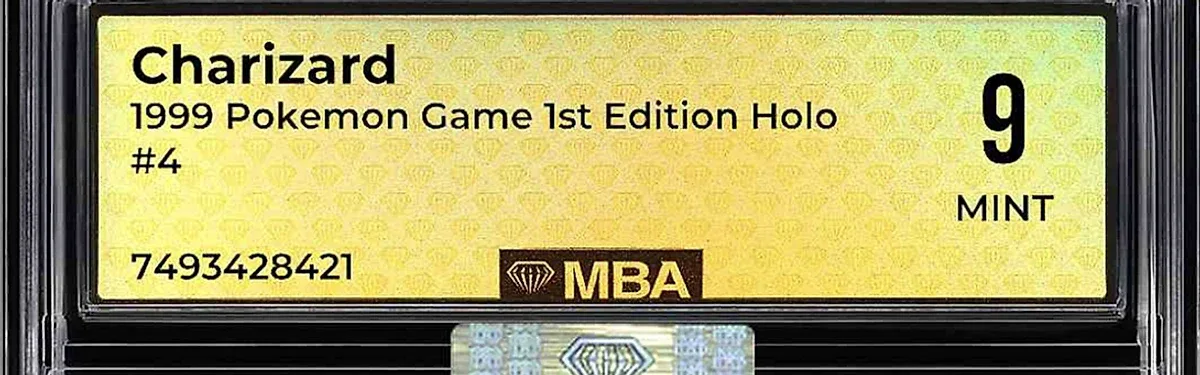
Two label systems. On MBA's own slabs, a metallic fraud-resistant label carries the technical grade. On other graders' slabs, a holographic Diamond sticker sits below the existing label in one of four tiers: Bronze confirms MBA agrees with the grade, Silver marks superior eye appeal in roughly the top 15% of the grade, Gold means MBA judged the card worth at least half a grade more, and Black is reserved for virtually flawless cards above Pristine. The sticker sits on someone else's label, which is exactly the point and exactly the objection.
Grader Use Cases
- Resale Value
- Long-Term Investment
- Condition Documentation
- Authentication
Two different decisions. As a sticker, it is worth considering only on a card already in a PSA, BGS, SGC or CGC holder where you believe the grade undersells it — a resale play, not a protection one. As a grader, MBA is aimed at cards under $250 that the majors price out, but its holder has no resale record yet, so that is a documentation-and-cost choice rather than a value one. Either way, raw submissions go through an approved business submitter rather than direct.
Known Concerns
Three, and they are structural rather than personal. First, a service paid only when it approves has an incentive pointing toward approval — the criticism levelled at every sticker service in every collectible category, and it does not require bad faith to matter. Second, MBA both assigns the sticker and publishes the scarcity claims that give it value; the percentages describing how rare a gold Diamond is cannot be checked by anyone outside the company, and forum regulars have said so directly. Third, at least one documented case has an MBA-stickered card rejected by PSA on crossover as altered stock, and Baker's association with Brent Huigens of PWCC — a marketplace accused of selling altered cards and ultimately banned from selling on eBay — sits uncomfortably beside a business built on the credibility of one person's eye. None of this is settled, and MBA's defenders point out the Diamonds are awarded sparingly.
On The Wire
What the hobby is saying about MBA (Mike Baker Authenticated), with our read on what it changes for you.
Nothing on the wire about MBA (Mike Baker Authenticated) yet — this fills in as it's collected.
History
Founded by Mike Baker, who was PSA's first employee and its Director of Grading for over a decade, and has graded professionally since 1991. MBA runs two lines. Raw Grading assigns an MBA technical grade on a 10-point scale and seals the card in an MBA holder, after what the company says was a two-year development of its encapsulation and fraud-prevention process. Crossover Grading is the sticker business: a tamper-proof holographic Diamond is applied below the existing authenticator's label, leaving the card in its PSA, SGC, BGS, CGC or TAG holder. A third path, Provenance Crossover, photographs the original label, opens the old slab and crosses the card into an MBA one, keeping the prior grade on the report card. Baker's history runs further back than PSA: after Global Authentication collapsed in 2009 he was director of grading at Global Authority, the company assembled from GAI's assets.