
Guide
Graders Take the Lowest Score. Find It Before They Do.
Centering, corners, edges, surface — what graders look for before you submit.
Graders assess four things: centering, corners, edges and surface. Learning to look at those four the way a grader does is the difference between submitting hopefully and submitting deliberately.
The rule that decides everything
The final grade is not an average of the four. It is the lowest of them.
A card that scores 9 on corners, 9 on edges, 8 on surface and 7 on centering is a 7. Not an 8.25. The weakest category caps the card, which is why a single flaw you talked yourself out of noticing is the whole result.
This is also why "it looks mint" is not an assessment. A card can be flawless in three categories and still be a 7.
Centering
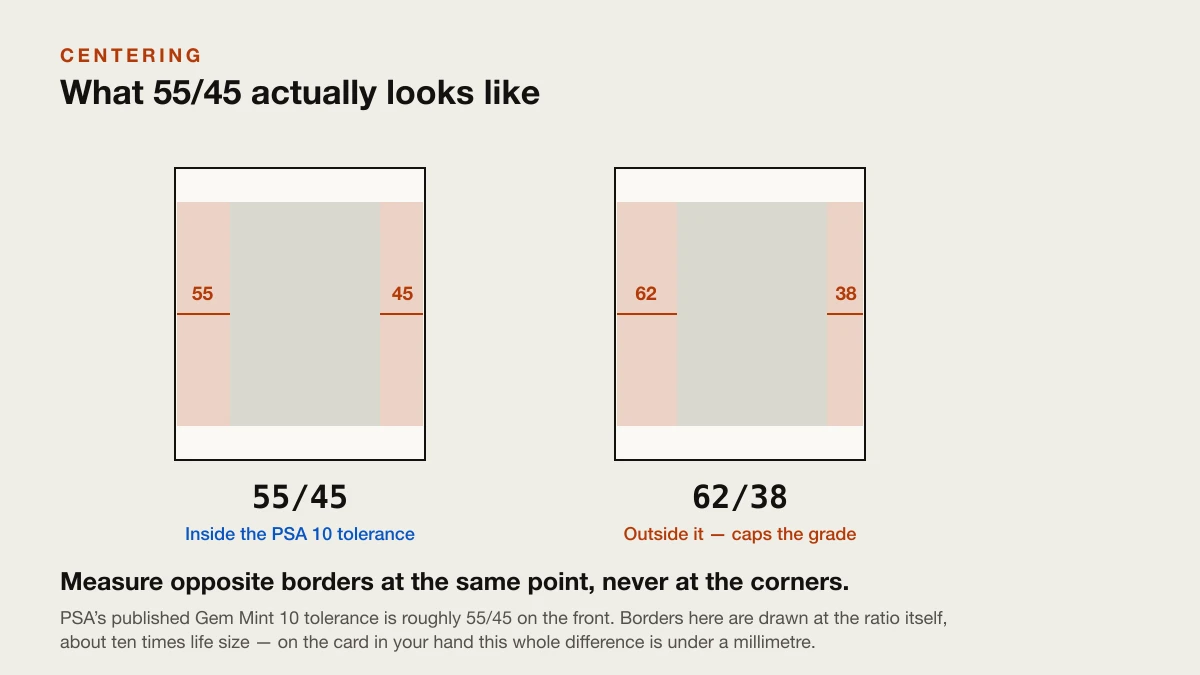
Centering is how evenly the image sits inside the borders, measured top to bottom and left to right, on both faces.
PSA's published standard for a Gem Mint 10 is roughly 55/45 on the front and 75/25 on the reverse. The front tolerance is the tight one, and it is tighter than most people assume — a border that looks slightly heavy on one side to the naked eye is often already outside it.
Measure rather than eyeball. Compare the border width on opposite sides at the same point, not at the corners, where cutting variation exaggerates the difference.
Corners
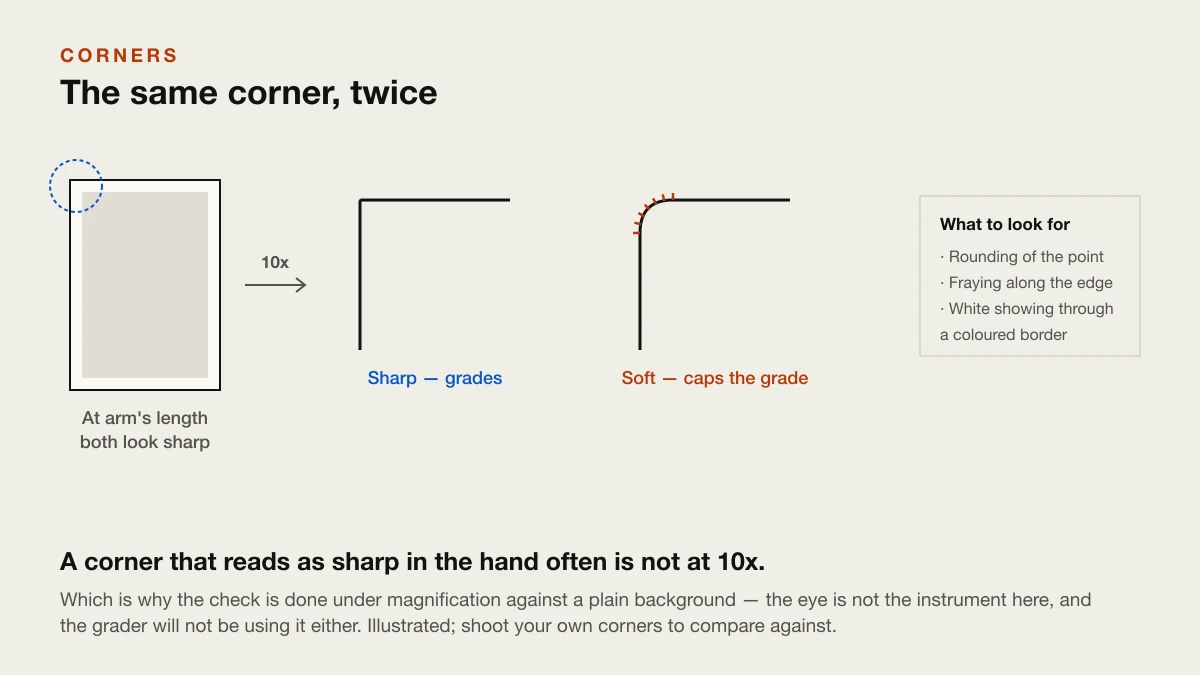
All four corners have to be sharp. Rounding, softness, fraying and the small white showing through a coloured border are all corner faults, and corners are where handling damage lands first.
Check them under magnification against a plain background. A corner that reads as sharp at arm's length frequently is not at 10x.
Edges
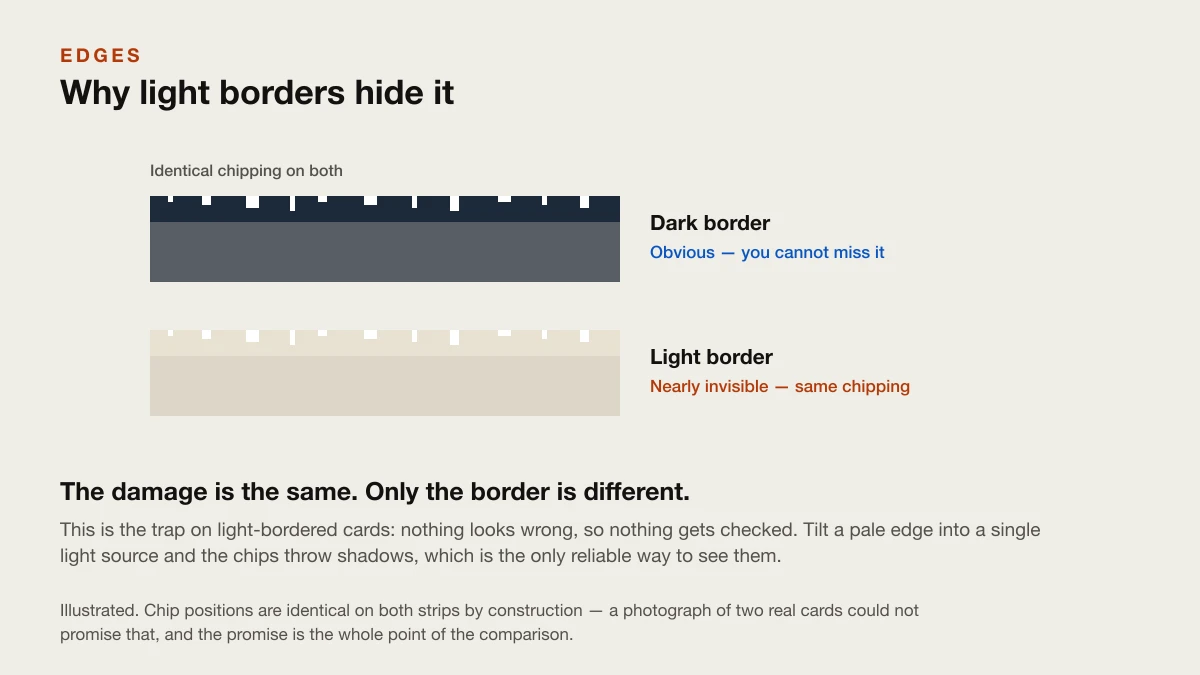
Edges should be clean and smooth, with no chipping, whitening or roughness from the cutting process. Coloured-border cards are the hard case: any white showing along an edge is obvious against dark ink and nearly invisible against a light design.
Surface
Surface is the broadest category and the one that most often caps a grade unexpectedly. It covers scratches, print defects, staining, dents, loss of gloss and anything else on the card face.
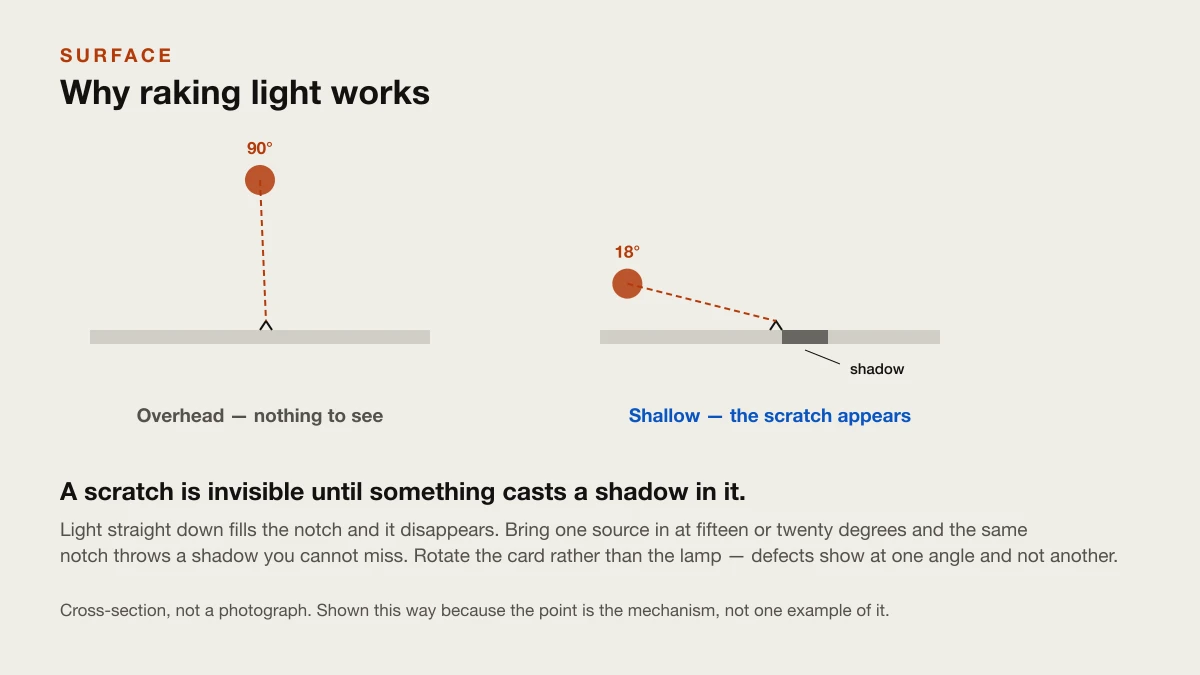
The technique worth learning is raking light. Hold the card at a shallow angle to a single light source and rotate it. Scratches and dents that are invisible under flat overhead light appear immediately.
- Look at both faces, at several angles.
- Check for print lines, which run in the direction the card was printed and are a manufacturing defect rather than damage.
- Check gloss consistency across the whole face; a dull patch reads as surface wear.
Grade the card you have
Once you have looked at all four, take the lowest and treat that as your expected grade. Then price the submission at that number rather than the one you would like — the arithmetic in our guide on evaluating card value only works if the grade going into it is honest.