
Guide
The Number Everyone Reads in a Pop Report Is the Wrong One
What the columns mean, why the gem rate matters more than the raw count, and the ways a pop figure misleads.
A population report is a running count of how many copies of one card a grading company has ever put in each grade. It is the closest thing the hobby has to a supply figure, and it is routinely misread — usually by looking at one number instead of the shape of the whole row.
Where to find it
PSA publishes its report at psacard.com/pop. That section sits behind a Collectors account sign-in, so you will need to be logged in to browse it. BGS and CGC publish their own equivalents; the numbers are not interchangeable, because each only counts cards that company graded.
What the columns mean
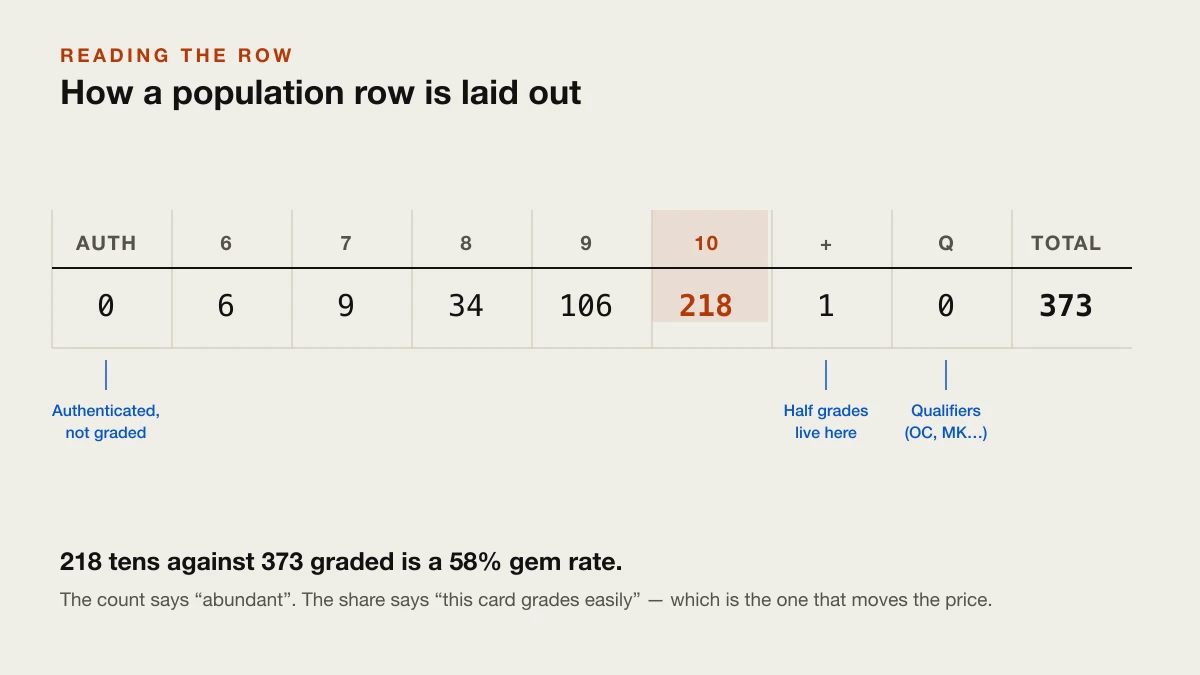
A row is one card. Reading left to right you get the card number and name, then a column for every grade, then a total.
- AUTH counts cards authenticated but not assigned a numeric grade.
- The numbered columns, 1 through 10, are the count at each whole grade.
- A "+" row carries half-grades, so a PSA 8.5 appears there rather than under 8 or 9.
- A "Q" row carries grades with qualifiers — OC for off-centre, for example. The card met the grade everywhere except one named flaw.
- TOTAL is every whole grade added together.
A real row looks like this: a Josh Allen DT1 with 6 at PSA 6, 9 at PSA 7, 34 at PSA 8, 106 at PSA 9 and 218 at PSA 10, for 373 graded copies and a single 8.5 in the half-grade row.
The number that actually matters
The population at a grade tells you very little on its own. What tells you something is that number as a share of the total — the gem rate:
- Gem rate = PSA 10 count divided by total graded, times 100.
- Under about 10% means the card is genuinely hard to grade well, and the 10 carries a real premium.
- Under about 5% and condition scarcity becomes a primary driver of the price rather than a footnote.
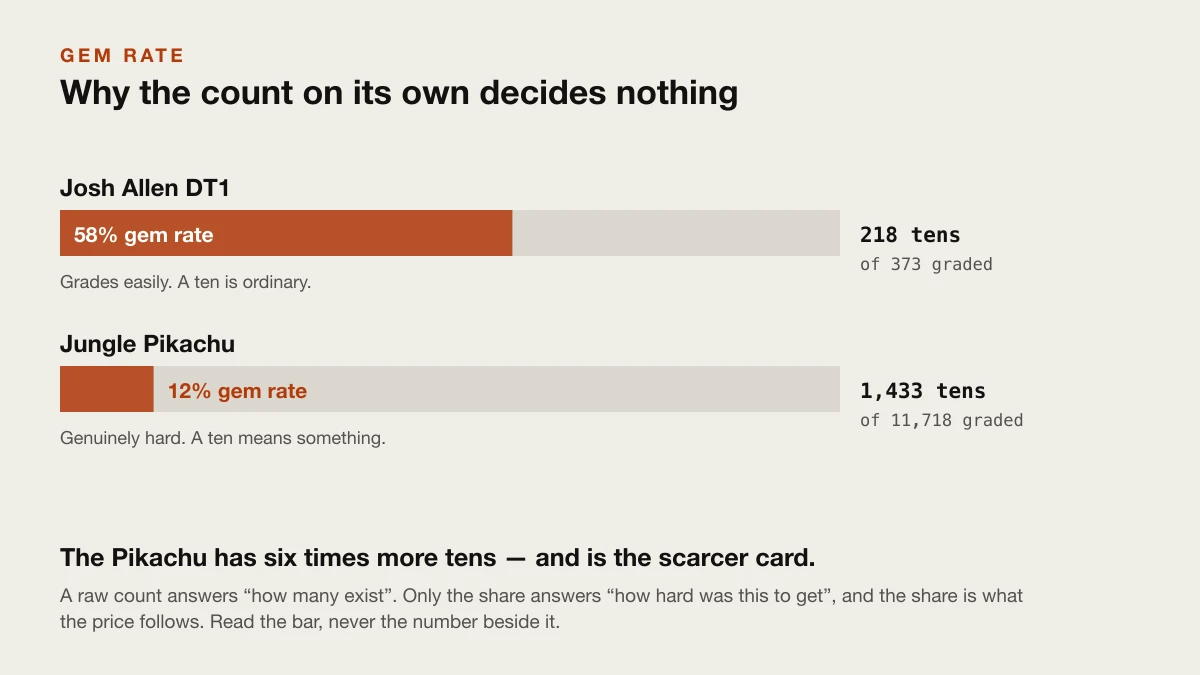
The Josh Allen row above is a 58% gem rate. That is a card that grades easily, and a PSA 10 of it is common rather than scarce, whatever the raw count says.
The mistake almost everyone makes
Compare the 10 population to the total, never to zero. A Jungle Pikachu with 1,433 PSA 10s sounds abundant until you see the 11,718 graded copies behind it, and it sounds scarce until you work out that the same figure is a 12% gem rate. The count in isolation supports whichever story you already believed.
Two more things worth holding on to:
- A pop report counts cards that were submitted, not cards that exist. A low population can mean a rare card or simply an unloved one that nobody bothered to grade.
- The count only goes up. Cards get cracked out and resubmitted, and the old entry is not removed, so a heavily resubmitted card is over-counted in the lower grades by an amount nobody can measure from outside.
Treat the number as evidence, not as truth
Population data is published by the same companies that profit from grading, and it is not audited. But it is a reason to treat a pop figure as one piece of evidence about supply rather than as a measurement, and to check the same card against a second grader's report when a decision turns on it.