
Guide
If the Cert Number Does Not Resolve, It Is Not a Slab
Real third-party grading vs. fake magnetic cases — how to tell the difference.
A slab is not a plastic case. It is a claim, made by a company willing to put its name on it, that a specific card is genuine and in a specific condition — and that the claim can be checked by anyone. The plastic is just how the claim is kept attached to the card.
That distinction matters because a great deal of plastic on the market looks like grading and is not.
The three-part test
Something is a slab if all three of these are true:
- An independent third party assigned the grade. Not the seller, not the owner.
- The holder is sealed, so the card inside cannot be swapped without visible damage.
- There is a certification number, and that number resolves in a public lookup anyone can query.
Fail any one and it is storage with a number printed on it.
What is not a slab
Magnetic one-touch holders and screwdowns. Excellent protection, sold in packs, openable by anyone in two seconds. A card in a one-touch is a raw card in good housing.
Toploaders and penny sleeves. The same, less expensively.
Self-graded cases. Holders sold with a blank or fillable label, so a seller can assign a grade themselves. The grade means precisely as much as the seller's word, because it is the seller's word.
Custom or novelty slabs. Display pieces that mimic the format of a graded holder. Fine as display, and a genuine problem in a resale listing photographed at an angle.
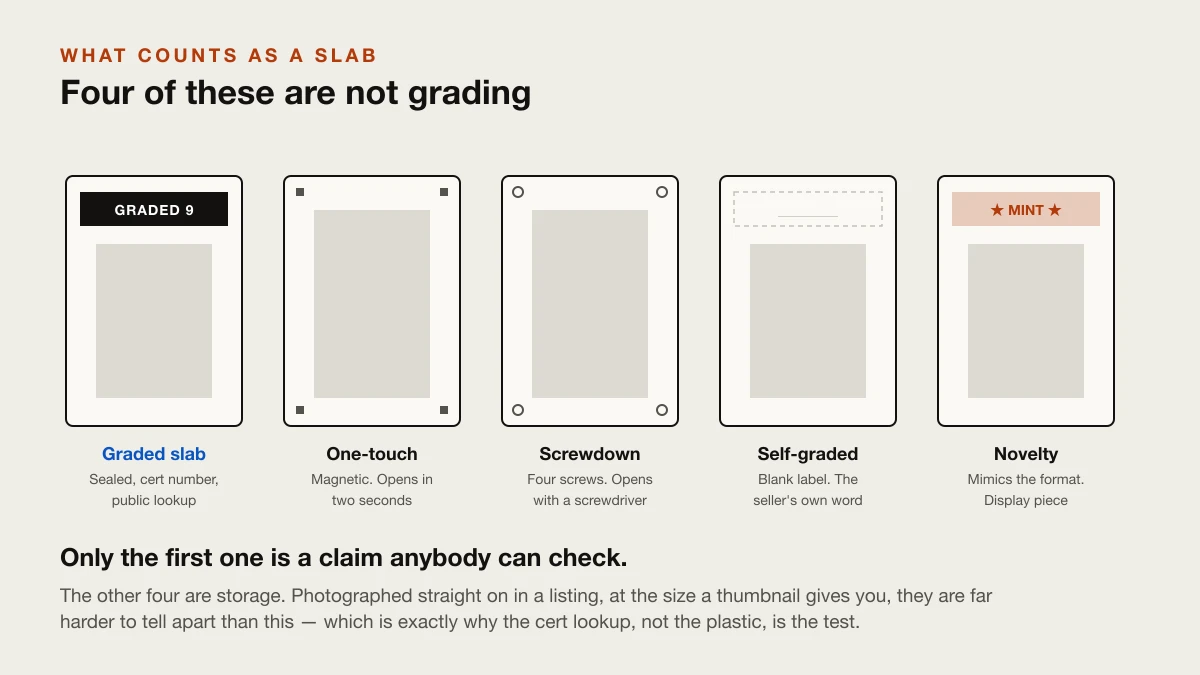
Why the cert lookup is the real line
Sealing and labelling are easy to imitate. A public certification database is not, because it requires the company to have actually graded the card, recorded it, and to keep that record queryable for anyone who later wants to check.
That is why every scorecard on this site records whether a grader publishes a cert lookup, and why "None found" is the single most damaging thing we can report about one. A buyer holding a slab they cannot verify is holding a card and a claim they have no way to test.
Before buying any graded card, type the cert number into the grading company's lookup and confirm three things match: the card, the grade, and the holder in front of you.
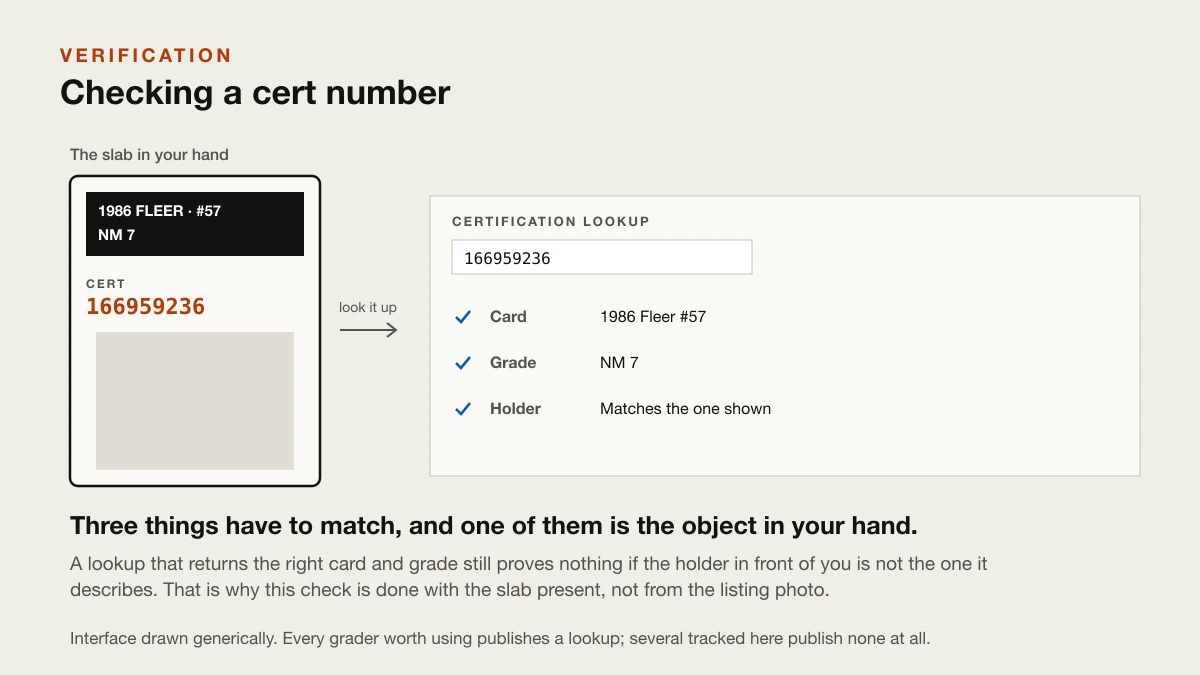
The failure mode this prevents
The scenario is not usually a counterfeit slab. It is more mundane: a card in a convincing holder from a company that either has no lookup or no longer exists, listed at graded-card money.
The card may well be exactly what the label says. The problem is that neither you nor your eventual buyer can demonstrate it, and an unverifiable claim prices like no claim at all.