
Guide
The Cheapest Grade on the Market Is the One You Cannot Sell
Red flags that separate real third-party grading from operations that won't hold value at resale.
There is no licence required to grade trading cards. Anyone can buy holders, print labels and start assigning numbers, and several operations do. The question is never whether a grader is allowed to exist — it is whether the market will pay for its opinion.
The test that settles it
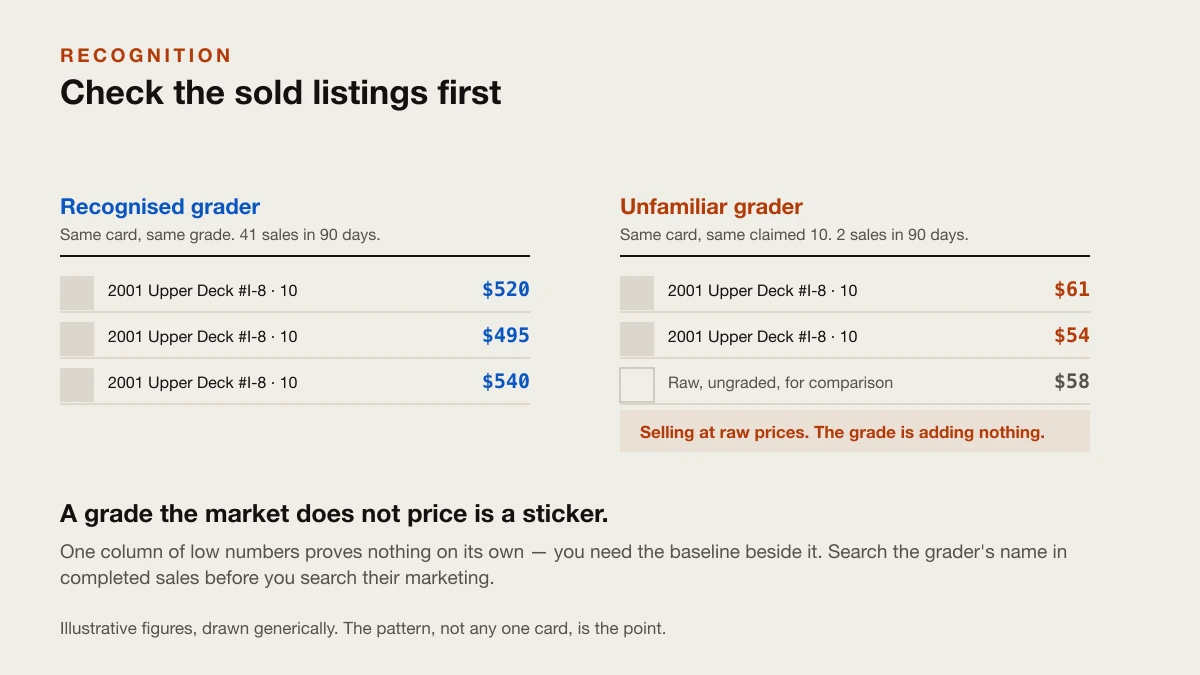
Before any other checking, do this: search sold listings for cards graded by that company.
Not active listings. Sold. If a grader's slabs are not selling, or are selling at raw-card prices, you have your answer, and no amount of marketing copy on their site changes it. Recognition is the whole product. A grade the market does not price is a sticker.
Red flags, roughly in order of severity
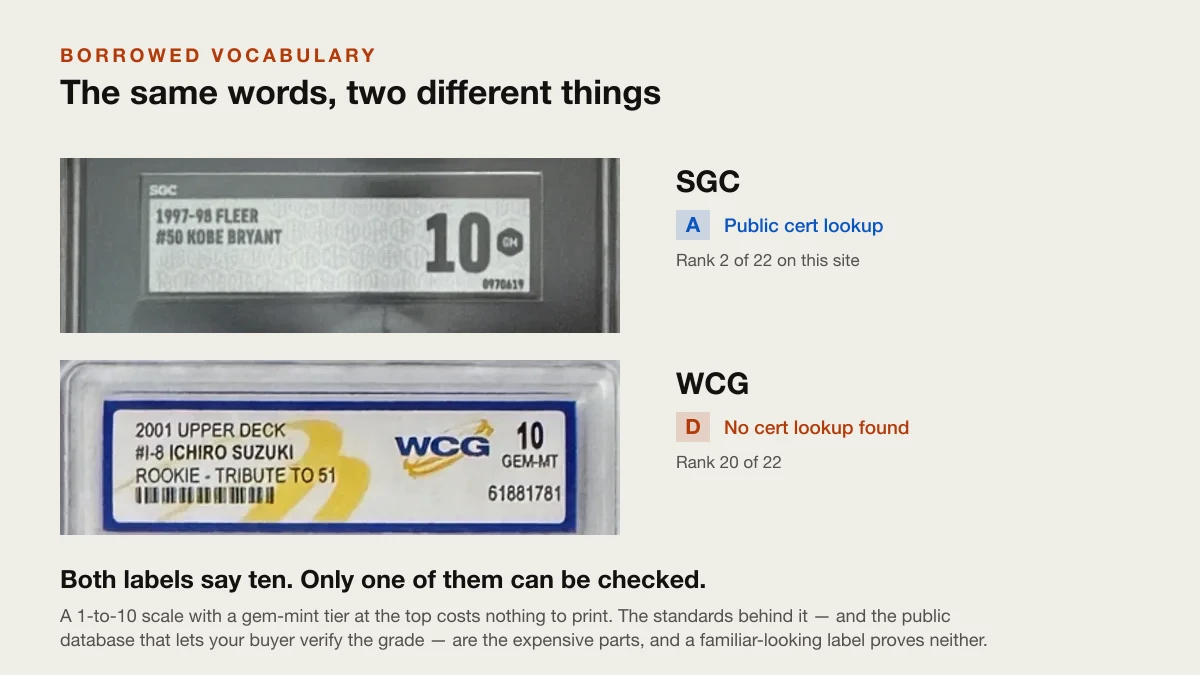
No public certification lookup. The most serious one. If a buyer cannot verify the slab in the grader's own database, the grade cannot be checked by anyone who was not in the room. Two of the operations we track publish no lookup at all.
No population report. Without one there is no way to know whether your 10 is one of five or one of fifty thousand, which makes the grade unpriceable even when it is honest.
Grades that mimic an established scale. A 1-to-10 scale with a "Gem Mint" tier at the top borrows the vocabulary of PSA and BGS without borrowing the standards. Familiar language is not evidence of comparable strictness.
Unpublished or negotiable pricing. Established graders publish tiers and turnaround times. "Contact us for a quote" on a grading service usually means the price depends on the card, which is a strange thing for a condition assessment to depend on.
Anonymous ownership and no history. Who owns the company, and since when. A grader founded recently, with no named principals, is asking you to trust a brand that has no track record to trust.
Grade inflation as a selling point. Any operation whose pitch is that it grades more generously than PSA is telling you its grades mean less. That is not a feature, and the resale market prices it accordingly.
What a legitimate grader looks like
The positives are the mirror image and are easy to check in an afternoon:
- A cert lookup that returns your card.
- A published population report.
- Published pricing and published turnaround times, both of which change and are updated when they do.
- Named ownership and a traceable corporate history.
- Slabs that appear in sold listings at a premium over raw.
The cheap-grading trap
The pitch for a no-name grader is almost always price. It is a genuine saving right up to the point where you try to sell.
A $12 grade on a slab that no buyer recognises has not saved you $38 against a $50 alternative. It has cost you $12 and produced a card that now presents worse than it did raw, because a slab from an unknown company invites a question that a plain card in a sleeve never raises.
Every scorecard on this site records cert lookup status, ownership, and how each grader's slabs are actually treated at eBay, at auction houses and in general resale. If you are weighing an unfamiliar name, start there.