On this page 9 sections
"AI grading" sounds like one thing. It isn't. It covers three different setups and three very different ways of looking at a card, and the second difference matters more than the first: a machine can only judge what its sensors capture. This guide walks through both, with the companies' own descriptions linked so you can check them.
The short version
- AI graders read the surface of a card, some of them in remarkable detail.
- None of them, as publicly described, sees beneath the surface, which is where skilled alterations and good fakes hide.
- Whether a machine-graded slab sells is a separate question, and the market answers it, not the technology.
Key terms
Machine vision. Software that analyzes images: finding edges, measuring borders, spotting marks.
Machine learning. Software that learns to score cards by being shown many examples, rather than following hand-written rules. TAG prefers this term to "AI."
Photometric stereo. Photographing an object several times with light from different directions, then working out the shape of its surface from how the shading changes.
Laser depth scan. Measuring the height of every point on a surface with a laser, usually by sweeping a laser line across it and watching how the line bends.
Fingerprinting. Storing detailed images of a card so the same card can be recognized if it comes back, for example after being cracked out and altered.
Human in the loop. A person reviews or decides what the software produced.
Three setups behind the label
| Setup | Who decides the grade | Example | In the company's own words |
|---|---|---|---|
| Machine-assisted | A human grader, helped by software | PSA (Genamint) | PSA's 2021 announcement |
| Machine-graded, human-checked | Software scores; a team confirms | TAG | TAG's grading process |
| Fully automated | Software alone | AGS | AGS's explanation of AI grading |
PSA bought the machine-vision company Genamint in 2021. PSA said the software provides "diagnostics, measurements," detects alterations to a card's surface and "fingerprints" each card, "in an effort to assist human graders." Its parent's chairman said, "We're not eliminating humans from the grading process."
TAG says cards are graded by "machine-learning software in conjunction with our patented image capture technology," and that a Verification team then confirms the results and reviews authenticity. Cards with questionable authenticity go back ungraded.
AGS says its grades come from "machine learning models trained on millions of data points" and "laser or depth mapping," and that AI "removes human bias." Our scorecard describes it as grading with no human assigning the grade.
These are the companies' descriptions of themselves. We haven't tested any of them.
How a machine sees a card
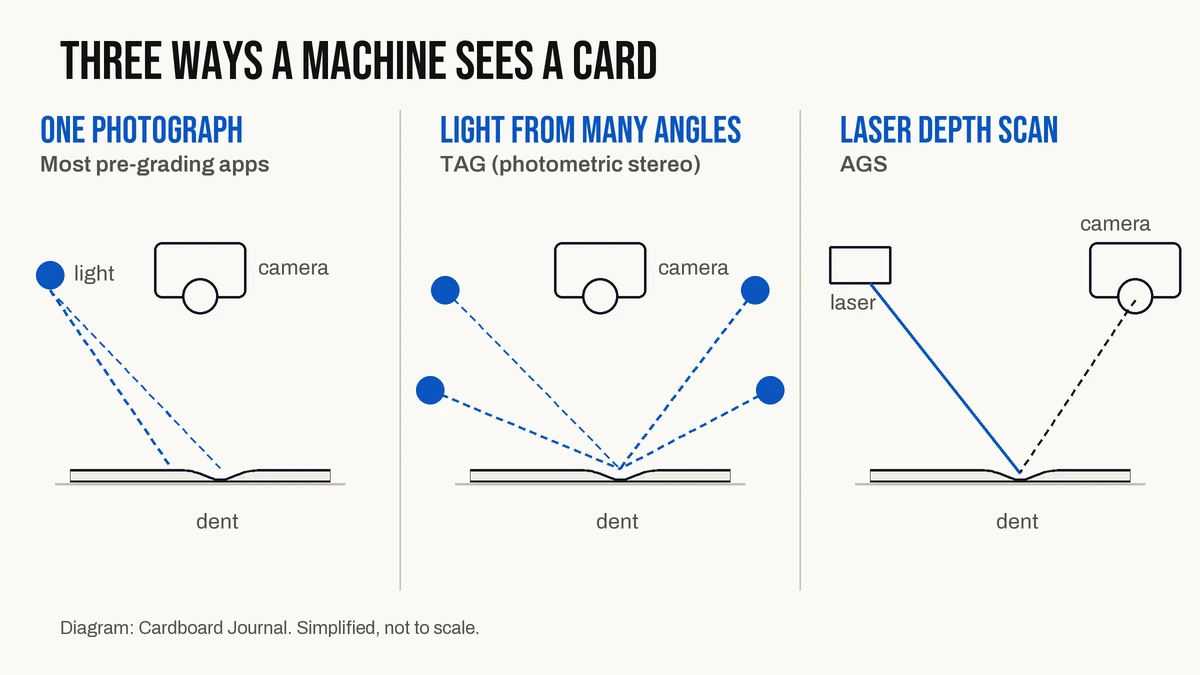
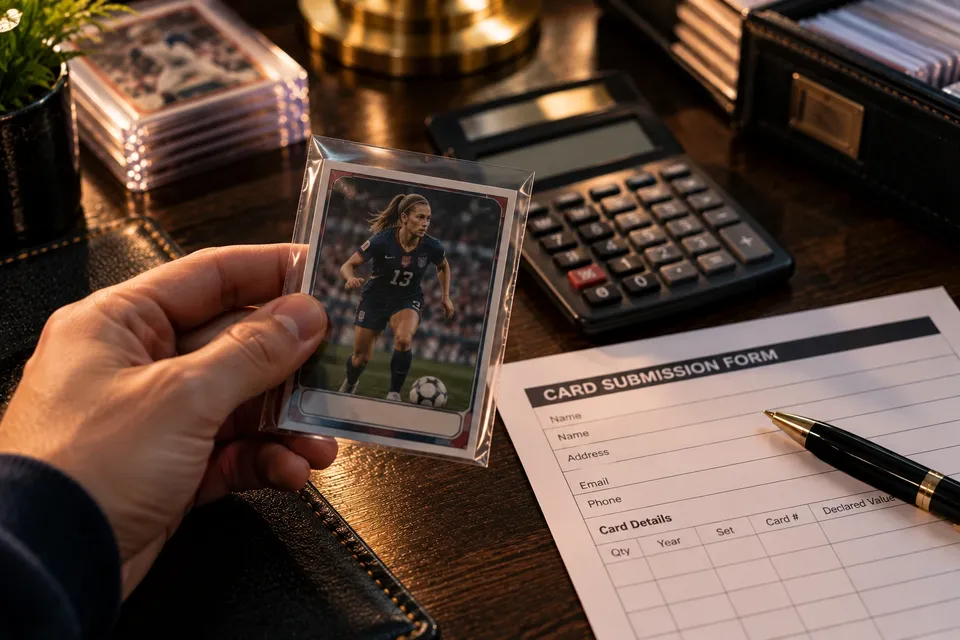
1. One photograph. A single camera and even light, the way a scanner or phone sees the card. Centering is easy, because it's just a ratio of border widths. Surface is hard: flat light hides the shallow dents and fine scratches that only show when light skims across them. Most AI pre-grading apps work from one uploaded photo.
2. Light from many angles (photometric stereo). TAG's method. The card is photographed several times, lit from a different direction each time. Software compares how bright each point is under each light and works out which way the surface tilts there. Put together, that's a map of the surface's shape. It's the systematic version of a grader tilting a card under a lamp. TAG's first patent, filed in 2015, describes computer-switched lights, comparison against a reference image of a clean copy, and more than 70 measurements rolled into a 1,000-point score.
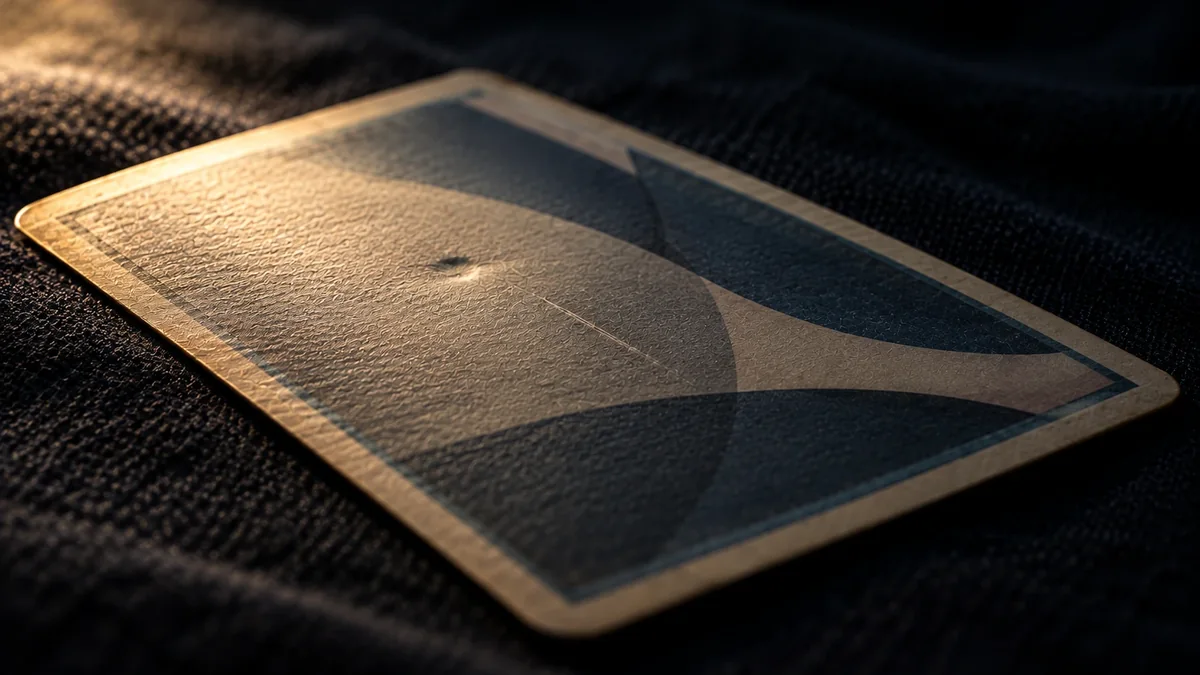
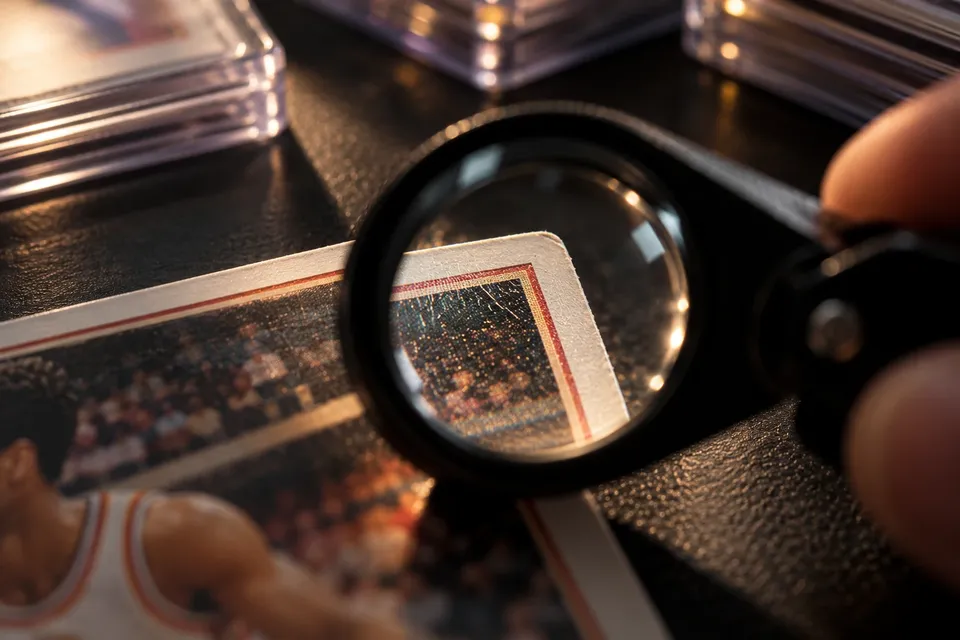
Illustration: light skimming across a card shows what a flat photo hides. Photometric stereo does this from several directions at once.
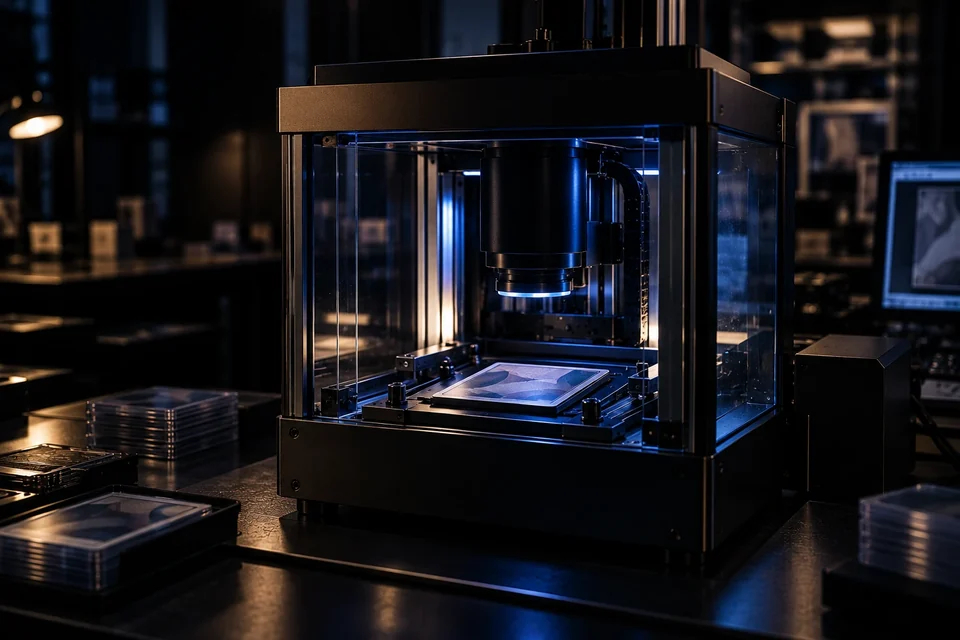
3. Laser depth scan. AGS's method. A laser scanner measures the height of the surface directly, point by point. The usual way to do that is to sweep a laser line across the object while a camera watches how the line bends over every bump and dip; AGS describes its system only as "laser or depth mapping." AGS returns a color-coded height map of a card's defects and says its scan captures roughly 28 million pixels per card. It's closer to a 3D scanner than a camera.
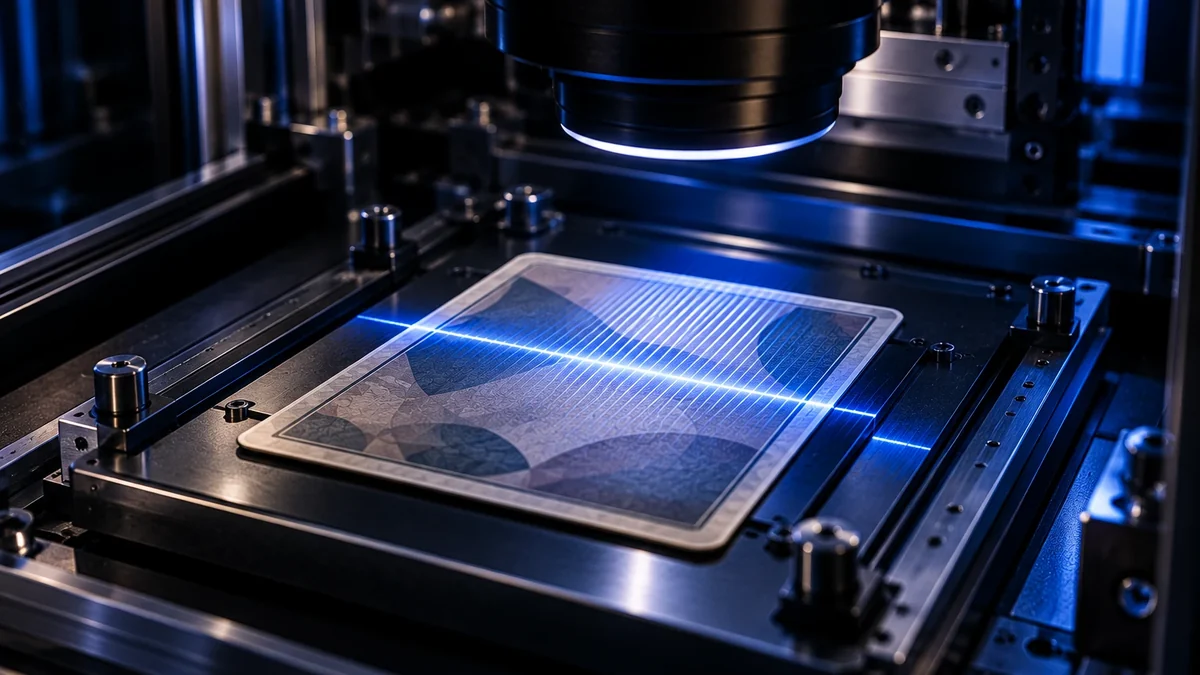
Illustration: a laser line sweeps across the card while a camera reads how it bends over the surface.
| Method | Best at | Weakest at | Who uses it |
|---|---|---|---|
| One photograph | Centering, obvious wear | Shallow dents, fine scratches | Pre-grading apps |
| Light from many angles | Scratches, print lines, surface texture | Measuring true height (it infers shape from shading) | TAG |
| Laser depth scan | Dents, bends, edge wear, anything with physical relief | Color and print defects that have no height | AGS |
Fingerprinting works on top of any of these. Genamint and TAG's patent both describe storing images so the same card can be recognized again. That's how a grader could catch a card that comes back altered.
What all three share: they see only the top surface, and only in visible light.
Is TAG the most technically advanced grader?
TAG markets itself as the technology leader. Its homepage calls its precision "unparalleled," and its founder's page describes a ten-year effort with "over 50 engineers and programmers" and "four patents with 134 approved Claims."
What's real: photometric stereo is a genuine step beyond a single photo for surface defects. TAG's 1,000-point score and its DIG report, which shows the defects it found on images of your own card, are more detailed than anything the traditional graders publish.
What isn't shown: independent tests of whether the same card gets the same score twice, or how its scores compare with a reference standard. Patents prove an idea was new when filed, not that it works better than anyone else's. And "most advanced" depends on what you measure: AGS measures height directly, which photometric stereo doesn't, and PSA runs Genamint at a scale nobody else matches, with details it doesn't publish.
Our read: TAG is the most transparent grader, and plausibly the most sophisticated at reading a card's surface. "Most advanced" is a marketing claim, not a measured one.
What the machines can't see yet
The hardest problems in grading aren't scratches. They are alterations made to look invisible: a trimmed edge, a recolored corner, a pressed-out crease, a rebuilt surface, and reprints good enough to pass a quick look. A skilled restorer works precisely so the surface looks right, and every machine above looks at the surface.
Museums and forensic document examiners have spent decades looking past it. What follows is our look at where card grading could go. No big grader says it uses these methods today.
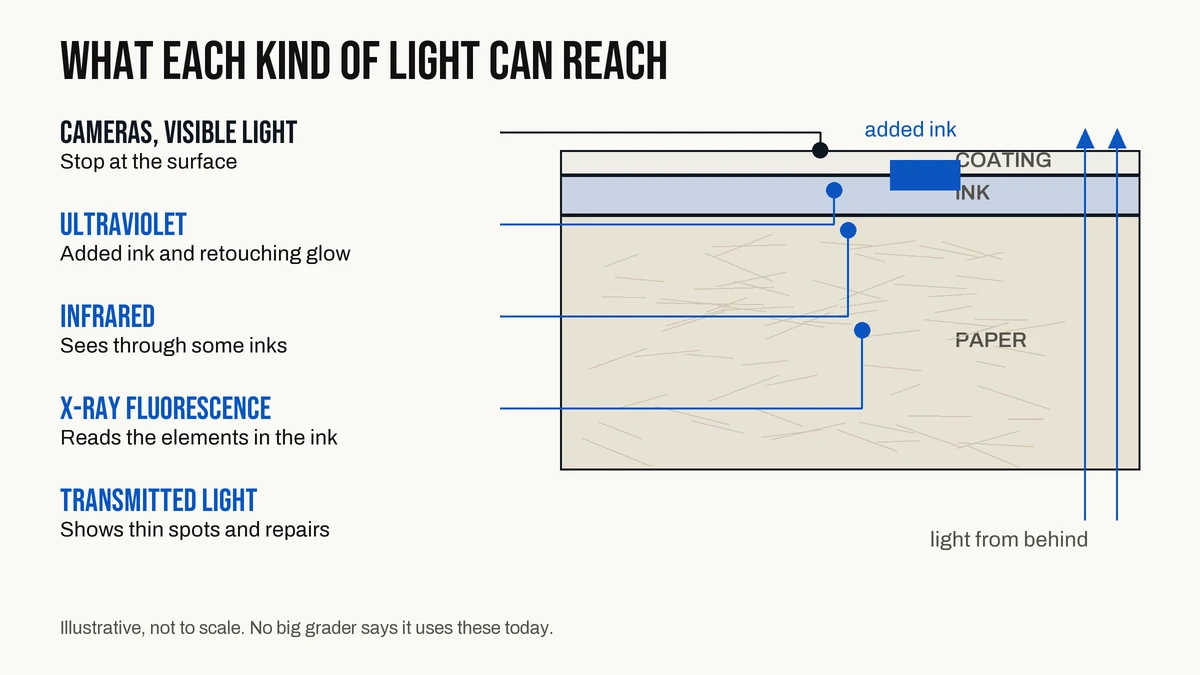
| Technique | What it shows | Where it's used now | What it could catch on a card |
|---|---|---|---|
| Ultraviolet light | Materials that glow differently: retouching, some inks, paper brighteners | Museums checking paintings for restoration; collectors with blacklights | Recoloring; a modern reprint of a vintage card |
| Infrared imaging | Through some paint and ink layers; inks that look identical to the eye | Museums revealing underdrawings; document examiners | Added ink that matches in color but not in chemistry |
| Hyperspectral imaging | A chemical signature for every point, across many narrow color bands | Separating original paint from later additions | Any patch of the surface that isn't original |
| X-ray fluorescence | The elements in an ink or pigment | Dating and authenticating paintings | Ink with an element that didn't exist when the card was printed |
| Transmitted light | Light through the paper: thin spots, repairs, the structure of the stock | Document and paper examination | Rebuilt or thinned paper; the wrong card stock |
Document examiners already combine several of these in one instrument. A video spectral comparator, used by forensic labs and border agencies to check passports and contracts, puts ultraviolet, infrared, raking and transmitted light in one box to expose erasures and forgeries.
Point that at a card, and recoloring stops being invisible, because added ink rarely matches the factory's ink chemically even when it matches to the eye. A trimmed edge exposes paper fibers that were never on the outside of a factory cut. And a grader that recorded a spectral fingerprint of every card it slabbed could recognize the same card if it came back changed.
Will a machine-graded slab sell?
That's what the score on this site measures, and it's a separate question from the technology.
- TAG is the strongest case. In the sold-price sample behind our score, a TAG 10 sells at about PSA 10 level for Pokémon cards. We don't have an equivalent sample for sports cards yet.
- AGS shows the other end. Collectors mostly treat it as a pre-screening tool. It scores 36 out of 100, in Tier D, with a Resale Standing of Raw value: on a high-value card, expect a buyer to crack it out and regrade it elsewhere.
Before you send cards to a machine-graded company
- Ask how it sees the card. One photo, light from many angles, or a laser depth scan. Each catches different things.
- Does the report show its working? An itemized defect list you can check against your own card is worth more than a bare number.
- Is there a public cert lookup? If a buyer can't verify the slab, that's a problem whatever technology is behind it.
- Does the market recognize the slab? Compare recent sold prices for your card in that grader's holder with the same card in a PSA slab.
- Is a person involved, and where? That tells you where the judgment sits.
- Start small. Send two or three cards you know well before you send a hundred.
About consistency
A machine applies the same rules every time, but whether it gives the same card the same score every time is a testable claim, and nobody independent has published the test. Ray Webb, a former director of education at PSA and at CGC's parent company, said in a recorded interview with Boston Card Hunter that some AI-driven graders have given the same card a 6 on one pass and a 10 on the next. That's one person's claim, and we haven't verified it. Scores right on the line between two grades are where any system, human or machine, is most likely to flip. And consistent isn't the same as accurate: a system can repeat the same wrong answer perfectly.
AI pre-grading apps are a separate case: they estimate from one phone photo, and the accuracy figures they publish come from the companies selling them. We've found no independent verification of any of them.
The bottom line
Machines are where grading has to go. Human graders are skilled, but people tire, disagree with one another and drift over time, and no company can hire its way to consistency at the volume the hobby now grades. Software applies the same rules to the millionth card as to the first. Every card a model learns from, and every improvement to the machines that capture it, makes the next grade more repeatable.
That repeatability is also the missing piece of a real grading standard. A shared standard needs a way to measure a card the same way every time, in any building, at any company. Machines can do that. People can't.
But a machine is only as good as what it's taught and what it can see. Today's best read the surface in remarkable detail, and none of them yet sees beneath it. Until the graders publish independent tests of their machines, and until the machines learn to see what a forger hides, consistent won't yet mean correct. The direction is right. The proof is still missing.