On this page 8 sections
You opened the pack. You sleeved the card right away. You never touched the surface. It came back an 8, and you can't see why.
You have plenty of company. Of the 2020s sports cards PSA graded in August 2025, about 42 percent got a 10, down from 53 percent in May 2024, according to GemRate figures compiled by Cardlines. And those were the cards people chose to send in, usually their best ones. The usual answer is that the card was never perfect in the first place.
"Fresh from the pack" is not "perfect"
Ray Webb, who trained graders as director of education at PSA and at CGC's parent company, put it bluntly in a recorded interview with Boston Card Hunter. The idea that a pack-fresh card is perfect, he said, doesn't hold up if you watch how cards are made. It is a dirty process, he said, and plenty can go wrong before the card ever reaches a pack.
That is his account, from his own experience, and not a claim about any one manufacturer. The process is imperfect everywhere, and every maker has the same steps to get wrong.
Where the defects come from
Two places, both before you ever see the card.
At the printer
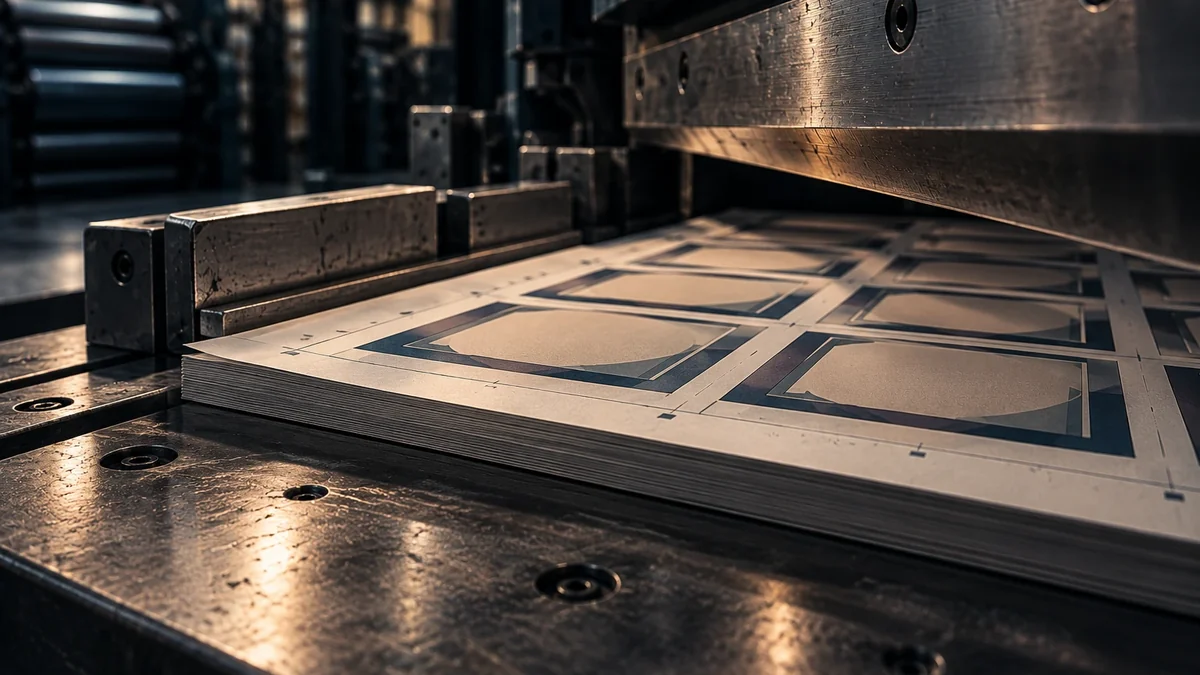
Illustration: Cardboard Journal. Not a photograph of a real print run.
Cutting and centering. Cards are printed in large sheets and cut apart. If the cut is off by a little, the borders are uneven. Centering is set when the card is made, not when you open it.
Print lines and roller marks. Fine lines or streaks in the ink can come from the press. They look like scratches and aren't.
Chipping. Dark borders show white where the ink flakes at the edge. On cards with dark borders it is the most common reason a pack-fresh card can't reach a top grade. Ray raised 1991 Score as a clear example of a product where the card, not the owner, sets the ceiling.
Quality control is meant to catch the worst of these, but it is checking millions of cards for obvious faults, not grading each one. A card can pass the factory's check and still miss a 10 by a hair.
When the packs are made
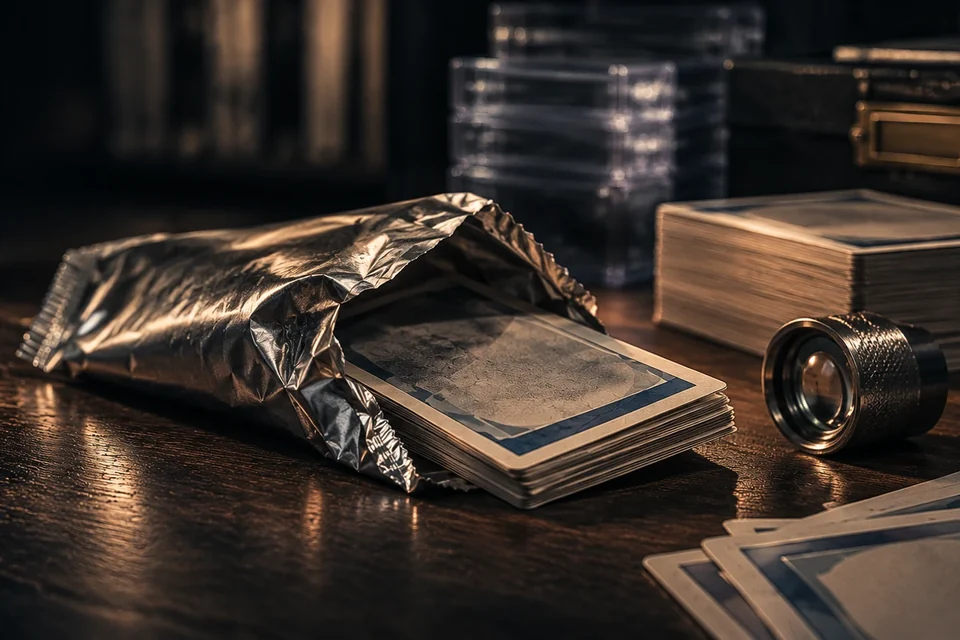
Sealing. Wrappers are heat-sealed and crimped shut around the stack of cards. The cards at the top and bottom of a pack can pick up dents or pressure marks along the sealed ends.
Collating and packing. Cards are stacked, sorted into packs and packed tightly into boxes and cases. Card rubbing against card can leave surface marks, and a tight box can ding a corner before it ever ships.
Why this matters before you submit
A factory defect is not wear. Careful handling keeps a card from getting worse. It doesn't undo something that was already there.
A grader sees it anyway. Graders grade the card in front of them. They aren't asked whether the defect happened at the factory.
So find it first. The time to spot a print line or an edge chip is before you pay, not after you get an 8 back.
Can you send a defective card back?
Sometimes. Some manufacturers take claims for damaged or defective cards. Topps, for example, takes them through a product-defect form on its website. Expect to show the card and proof of purchase, expect the maker to judge whether the damage is bad enough, and expect a wait: a replacement can take months, often six or more. A numbered card or a one-of-one may not come back as the same card, because there may not be another copy to send.
Worth it for a rare card: a numbered parallel, a one-of-one, a big autograph or relic.
Usually not worth it for a base card. The postage and the wait cost more than the card, unless it's a card a collector of that player or set would particularly want.
Is a printing error worth money?
Usually not. Most printing defects just lower the grade.
The exception is an error the manufacturer caught and fixed partway through production, so only a short run of one version exists. Then collectors chase the scarce version.
The best-known case is the 1989 Fleer Billy Ripken card, which showed an obscenity written on the knob of his bat. Fleer covered it up in several ways over the following print runs. According to Sports Illustrated's tally of PSA's population reports, PSA has graded more than 33,000 copies of the original error. Two of the short-lived fixes, the white-out and the white scribble over the knob, have only 237 and 165 graded copies, and PSA 10s of those have sold for thousands of dollars.
So the value came from the correction, not the mistake. A print line on your card is not that.
What to do before you pay to grade
- Look at the borders first if the card has dark ones. Check every edge for white flecks.
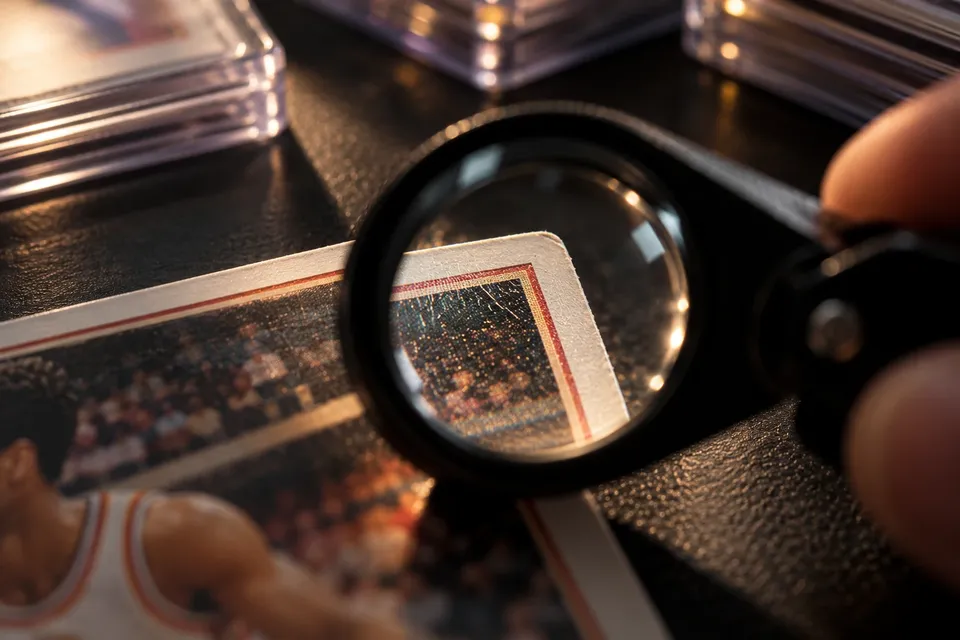
- Tilt the card under a single bright light and look for faint lines across the surface. Print lines show up when the light skims across.
- Check centering by comparing the border widths on all four sides.
- Try an AI pre-grading app. Several apps, such as GradeMyCard, Binder AI and CardGrader.AI, estimate a grade from phone photos. Treat the result as a screen, not a grade. We found no independent tests of their accuracy, and one photo is weak at showing the surface (our guide to what AI grading machines see explains why). Try one on a few cards you've already had graded and see whether it agrees.
- Ask other collectors. Post clear photos, front and back, plus one tilted under a light, in a collector community for that sport or game, such as a subreddit, Facebook group or Discord, and ask what they see. It's free, and plenty of people there have seen thousands of cards come back from graders.
- Look up the population report for the set and card. If top grades are rare for a card pulled from packs, that is the product telling you what to expect, not bad luck.
- Price one grade lower. If a card needs a top grade to pay for itself and is a known problem card, the math is probably worse than it looks. Our guide Most Cards Should Not Be Graded walks through the arithmetic.
What we couldn't find
We looked for anything the major card manufacturers publish about their quality control, such as how many cards fail inspection, and found no public account. If a maker has one, we'd quote it. Until then, the closest thing to a defect rate is what the graders report: how many cards come back a 10.
The one-line version
If a card was flawed before the pack was sealed, handling it carefully afterward doesn't make it mint. Check for what the factory put in before you send it, and price the result in.